
We run website design, SEO, and content writing for Halifax-area firms and practices across Nova Scotia. Below you’ll find our services, the local legal landscape, practice areas, and pricing.
Table of Contents
- Why Halifax Law Firms Need a Marketing Strategy
- Digital Marketing Services for Halifax Law Firms
- Law Firm Web Design in Halifax and Atlantic Canada
- The Halifax Legal Market
- Dartmouth, Bedford, and the Communities of HRM
- Truro and the Surrounding Region
- Halifax in Canadian Legal History
- How Much Does Law Firm Marketing Cost in Halifax?
- Nova Scotia's Practice Area Landscape
- Practice Areas We Market in Halifax
- Keywords Halifax Law Firms Should Target
- Get Started with a Free Marketing Audit
- Frequently Asked Questions
Why Halifax Law Firms Need a Marketing Strategy
Halifax is the anchor of the Atlantic Canadian legal economy. The Halifax Regional Municipality crossed the half-million mark in 2024 at an estimated 503,037 residents, which puts it well ahead of every other city east of Quebec. Add the satellite towns of Truro, New Glasgow, and Bridgewater, and the catchment covers most of Nova Scotia's roughly one million residents. Virtually every legal intake in the province routes through a lawyer who either sits in HRM or drives in from a regional office nearby.
The search engine is where those intakes begin. A collision on Highway 102 between HRM and Truro, a divorce in a subdivision that did not exist five years ago, a weapons charge moving through Provincial Court on Spring Garden Road, a closing on a peninsula house sold two hours after the listing went up, a post-graduation work permit application filed by a Dalhousie international student -- each of those starts with a Google query, usually on a phone, usually within a day or two of the event.
Firms that do not surface on page one simply are not in the conversation. Whatever the practice book, the ranking competitor is the one collecting the call.
That is the gap we close. Our client roster is law firms only. We work inside Rule 7 of the Nova Scotia Barristers' Society Code of Professional Conduct on advertising and solicitation, we know how Halifax, Dartmouth, and Bedford compete as distinct local ecosystems even inside a single municipality, and we know the search volume curves for every Nova Scotian practice area worth ranking for. General-vertical agencies do not carry that knowledge. We do.
Digital Marketing Services for Halifax Law Firms
Website Design for Halifax Law Firms
Our law firm website design work in Halifax starts from one premise: a site that never ranks is just an expensive placeholder. Atlantic Canadian prospects do not scroll past the first few results, and the firm that lands above the fold wins the retainer.
Every site we build puts speed, ranking, and conversion ahead of visual polish. The look comes after the structure. Each project ships with legal-industry schema, WCAG 2.1 AA accessibility, mobile-first layouts designed from the phone upward, and consultation forms placed where a stressed visitor will actually find them. Mobile load times stay under two seconds whether the visitor is browsing from a Spring Garden Road coffee shop, a Bedford Basin kitchen, or a Truro waiting room. Those performance numbers are not a design preference. They are how Google decides which Halifax law firm gets the top of the results page in 2026.
Search Engine Optimization (SEO) for Halifax Law Firms
Law firm SEO Halifax decides which firm surfaces when a potential client types "personal injury lawyer Halifax," "family lawyer Dartmouth," or "real estate lawyer Bedford Nova Scotia." Our engagements cover both halves of the discipline at once: the infrastructure layer (Core Web Vitals, structured data, crawl budget, information architecture) and the editorial layer (practice-area pages, geographically targeted writing, keyword mapping that follows actual intent, linkable assets).
Halifax is the dominant Atlantic bar, but the search competition is a fraction of what a Toronto or Vancouver firm faces. A tightly executed campaign here moves high-value keywords onto page one in the six-month range, on monthly budgets that would not cover a week of paid ads in the Ontario metros. Nova Scotia remains one of the best ratios of keyword difficulty to legal value anywhere in the country.
Google Business Profile Optimization for Halifax
For "lawyer near me" and city-prefix searches in HRM, Google pins its three-pack map listings above the first organic result. A substantial share of mobile searchers tap a map card before they ever scroll to the blue links underneath.
We manage every lever on that listing: consistent NAP records, deliberate primary and secondary category choices, service-area definitions, booking links, photography refreshes, posting cadence, and a review-generation program designed to stay inside NSBS Rule 7. Google treats Halifax, Dartmouth, and Bedford as three separate local markets, not one HRM blob. A firm with offices on both sides of the harbour therefore needs two Google Business Profile listings, two distinct optimization plans, and two location-specific landing pages feeding into them. Collapsing them into one listing is among the fastest ways to give away a map presence that took real work to earn.
Content Marketing for Halifax Law Firms
Legal content writing for Halifax law firms is one of LawOnline's core services. We produce practice-area pages, FAQ banks, and longer articles built around content marketing for law firms -- answering the exact questions Halifax, Dartmouth, Bedford, and Truro residents type when a legal problem lands on the kitchen counter. Every piece is written by a human who researches the applicable statute before they start writing. That means the Motor Vehicle Act, the Parenting and Support Act, the Limitation of Actions Act, and the Residential Tenancies Act for the practice areas they govern, and the Provincial Court Act for anything touching procedure. Every draft passes an NSBS advertising review before it reaches the client for publication. We do not put AI slop under your firm's byline.
Website Migrations and Hosting
If your current host or CMS is capping your rankings, we handle the replacement from planning through post-launch monitoring. That covers a 301 strategy mapped from the existing URL inventory, staged redirect testing before cutover, coordinated DNS handover, and rank tracking through the first weeks on the new platform so the organic visibility the firm has already earned comes through the move intact.
Law Firm Web Design in Halifax and Atlantic Canada
Halifax is the only major legal market east of Quebec, and that isolation creates a web design opportunity most firms haven't acted on. Digital adoption among Nova Scotia law firms lags the national average, which means a well-built website can dominate local search results faster and at lower cost than in any comparably sized market in Ontario or Western Canada. The firms that move first will own page one for years before competitors catch up.
What makes Halifax different starts with the geography. HRM spans a vast municipal footprint, and Google treats Halifax, Dartmouth, and Bedford as three separate local markets despite sharing a single regional government. A personal injury firm on the peninsula that also takes collision files from the Bedford Highway and Highway 102 needs dedicated pages for each community, or it's invisible to searchers on the other side of the harbour. The Macdonald and MacKay bridges move tens of thousands of vehicles between Halifax and Dartmouth daily, and the motor vehicle accident files that flow from that traffic volume are searched by community, not by municipality.
The Nova Scotia Barristers' Society enforces its own advertising rules under Rule 7 of the Code of Professional Conduct, and those rules differ from LSO and LSA requirements in ways that generic web agencies don't account for. Testimonial restrictions, solicitation limits, and mandatory disclaimers all need to be built into the site's architecture from day one, not patched in after launch. For PI firms, family practices, and criminal defence lawyers competing in the Halifax market, a site that doesn't meet NSBS standards is a compliance risk on top of being a missed ranking opportunity. For a detailed breakdown of what Nova Scotia lawyers can and can't say in their marketing, see our guide to Atlantic Canada lawyer advertising rules.
We build law firm websites for Halifax and Atlantic Canada with NSBS compliance, mobile-first performance, and location pages spanning Halifax, Dartmouth, Bedford, and beyond. See our professional law firm websites page for the full approach.
The Halifax Legal Market
Halifax carries the provincial capital, the seat of government, the largest concentration of employers in Atlantic Canada, a full military and defence establishment, and an international container port. It also houses the oldest university-based common law school in the country. That mix produces a legal market denser and broader than anywhere else in the region.
The numbers confirm the picture. The Nova Scotia Barristers' Society's annual report recorded 1,502 practising lawyers based in Halifax Regional Municipality in 2021, which accounts for 69.9% of the provincial bar. Just under half the province's lawyers (49.6%) work in private practice, divided between partners (26.2%) and associates or other private-sector roles (23.4%). The remainder sit in government, legal aid, sole practice, and in-house roles.
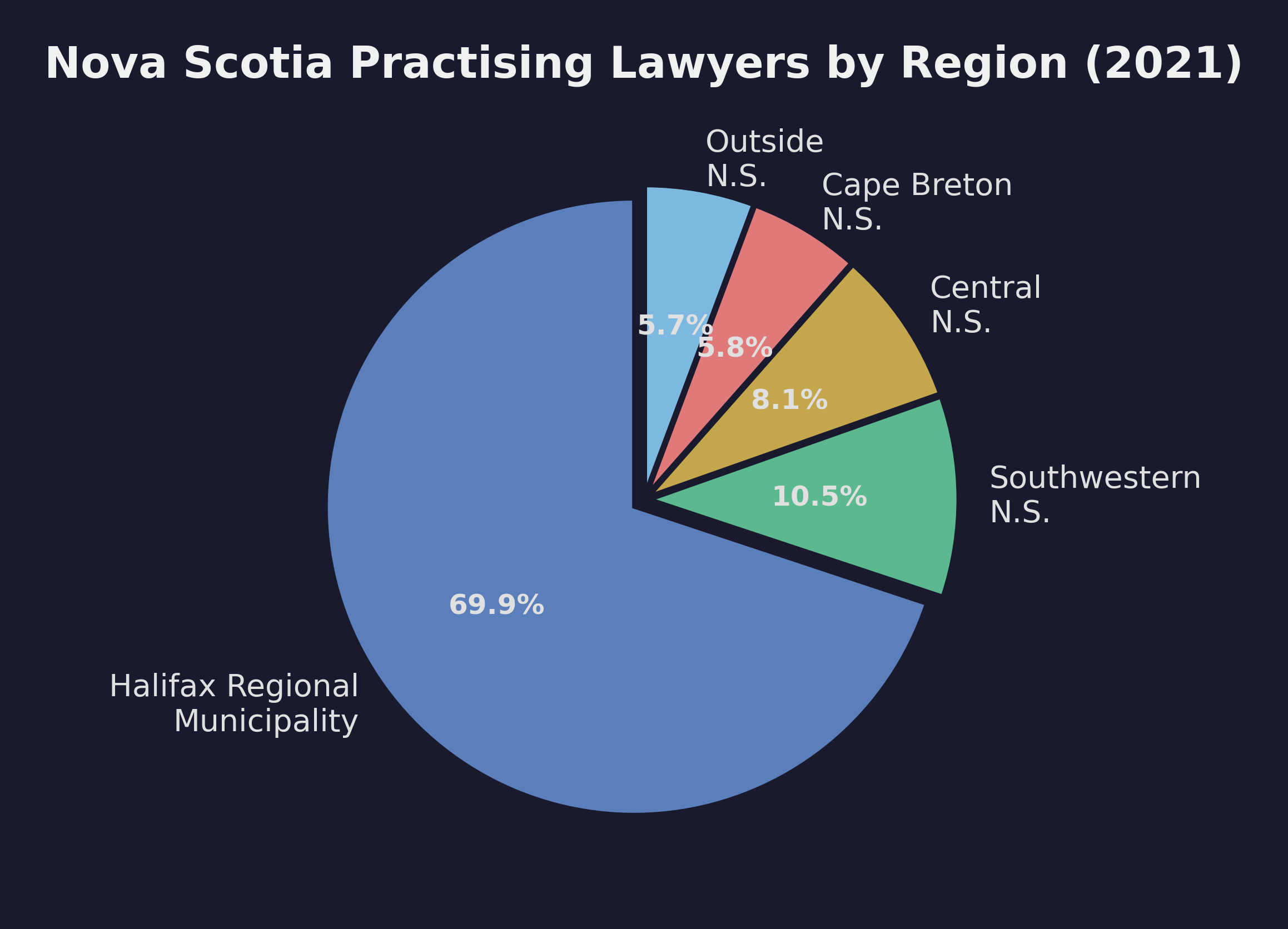
An Atlantic-scale opportunity. HRM is the only large legal market east of Quebec. Paid-search and organic competition here are a fraction of what firms face in Toronto, Vancouver, or Calgary. That gap rewards any Halifax firm willing to invest in digital presence.
The Halifax Law Courts at 1815 Upper Water Street house the Nova Scotia Court of Appeal and the Supreme Court of Nova Scotia. The Provincial Court sits in the historic 1863 courthouse on Spring Garden Road. Family Court files are heard at 3380 Devonshire Avenue. A satellite courthouse at 277 Pleasant Street in Dartmouth handles criminal jury trials and some civil work. That multi-building footprint means firms need visibility across every HRM community, not just the peninsula.
The Schulich School of Law at Dalhousie University was founded in 1883, making it the oldest university-based common law school in Canada. It feeds a steady pipeline of articling students and new calls into the HRM bar and keeps Halifax in the intellectual centre of Atlantic Canadian legal practice.
The Canadian Bar Association - Nova Scotia Branch runs CPD, sections, advocacy, and networking programs for the provincial bar, and its programming is concentrated in Halifax.
Population growth. HRM passed the 500,000 threshold in 2024 at 503,037 residents. It is the fastest-growing municipality in Atlantic Canada, lifted by interprovincial migration from Ontario and Alberta alongside substantial international immigration. New arrivals translate directly into real estate closings, family retainers, immigration files, and estate planning.
A market cycling through generations. New law firm registrations in Nova Scotia hit 41 in 2022 while retirements ran to 53 the same year. That combination of departing senior practitioners and incoming new calls leaves intake channels open for firms positioned to pick up the referrals and the search traffic those retirements release.
Federal litigation hub. Halifax carries the Federal Court and Tax Court of Canada sittings for Atlantic Canada. Federal immigration judicial reviews, tax appeals, maritime and admiralty files, and Indigenous law matters all surface through the Halifax registry. That volume rides on top of the provincial docket.
Dartmouth, Bedford, and the Communities of HRM
Halifax Regional Municipality is one of the largest municipalities in North America by land area. The modern HRM came together in 1996 when the province amalgamated the former cities of Halifax and Dartmouth, the town of Bedford, and Halifax County into a single tier of government.
Dartmouth. Across the harbour from the Halifax peninsula, joined to it by the Angus L. Macdonald and A. Murray MacKay bridges. The "City of Lakes" retains a commercial core independent of downtown Halifax, its own growing residential base, and a satellite courthouse at 277 Pleasant Street. Dartmouth searchers mix "lawyer Dartmouth" and "lawyer Halifax" queries interchangeably, so a firm that wants the intake needs to optimize for both.
Bedford. A suburban community in the northwest corner of HRM, set along the Bedford Basin. Median household income runs above the HRM average, and the demographic profile feeds a steady pipeline of real estate closings, estate planning files, and family retainers.
Lower Sackville. One of HRM's largest suburban nodes, seated along Highway 101 northwest of the peninsula. Its population and commuter patterns produce demand across most practice areas, including a substantial share of routine criminal defence matters.
Cole Harbour and Eastern Passage. Communities on the municipality's eastern shore, growing steadily and contributing to the overall HRM intake pool without yet supporting their own dedicated firms at scale.
Truro and the Surrounding Region
Truro sits roughly 100 kilometres north of Halifax along Highway 102 and operates as the commercial hub of Colchester County. Population of about 13,000 makes it the third-largest town in Nova Scotia. Truro has its own Provincial Court and generates a continuous stream of family, criminal defence, real estate, and personal injury work. A meaningful share of Truro-area intakes also travels south to Halifax for specialist work, while several HRM firms actively target clients from across the province on their websites.
Halifax in Canadian Legal History
Nova Scotia's legal record runs unusually deep for a city its size. Halifax was founded in 1749, and its courts have been shaping Canadian law for nearly three centuries.
The Halifax Court House at 1815 Upper Water Street, and the older provincial courthouse on Spring Garden Road, together anchor one of the most historically significant court complexes in the country. The Spring Garden Road building was completed in 1863, with an east wing added in 1930. The Historic Sites and Monuments Board of Canada has designated it a national historic site. In 1985 it was restored to active service as a Provincial Court facility, which is still its role today.
In 1835 the Supreme Court of Nova Scotia heard the criminal libel trial of Joseph Howe. Howe, the publisher of the Novascotian, had printed letters alleging corruption by Halifax magistrates and police. He defended himself, addressed the jury for six and a quarter hours, and was acquitted. The verdict is treated as the first recognition in a Canadian court that truthful criticism of public officials is protected speech, and it remains a foundational reference in Canadian media and constitutional law.
In Annapolis Group Inc. v. Halifax Regional Municipality, 2022 SCC 36, the Supreme Court of Canada reshaped the test for constructive taking. The dispute arose from 965 acres of Annapolis Group development land on the Halifax peninsula that the municipality had frozen from development under its regional plan. In a 5-4 decision, the Court held that a regulatory scheme can amount to a de facto expropriation even where the municipality never acquires formal title to the property. The ruling now governs constructive-taking arguments in every Canadian jurisdiction.
How Much Does Law Firm Marketing Cost in Halifax?
Halifax sits in the small-to-mid-market tier of Canadian legal marketing pricing. It is well below Toronto and Vancouver, roughly in line with Ottawa and Winnipeg, and slightly above Moncton or Charlottetown. Nova Scotia consistently ranks as one of the most cost-effective provinces in the country for digital marketing services delivered to law firms.
| Service | Typical Cost Range |
|---|---|
| Local SEO retainer (monthly) | $1,500 to $3,000 |
| Custom law firm website | $3,000 to $10,000 |
| Full-service marketing package (monthly) | $2,500 to $4,500 |
| Content writing (monthly) | $800 to $2,000 |
Firms competing in the crowded Halifax practice areas (personal injury, criminal defence, and family law) should plan to land near the upper end of each range. Dartmouth-, Bedford-, and Truro-specific campaigns can deliver strong returns at the lower end because the search competition is thinner outside the core peninsula market.
Across every category, Halifax pricing runs 25 to 35% below the Toronto equivalent. Our model keeps overhead low, focuses exclusively on Canadian law firms, and delivers metro-quality strategy at Atlantic rates. The spend stretches further and the work is tighter.
Nova Scotia's Practice Area Landscape
The NSBS 2025 Statistical Snapshot lays out the practice distribution across the Nova Scotia bar. Corporate/Commercial/Banking leads at 10.4% of practising lawyers, followed by Real Estate at 9.0% and Criminal Prosecution at 7.3%. Criminal Prosecution posted the largest year-over-year gain (+0.6%), while Wills/Estates/Trusts rose to 6.5% (+0.5%) in step with the province's aging population curve.
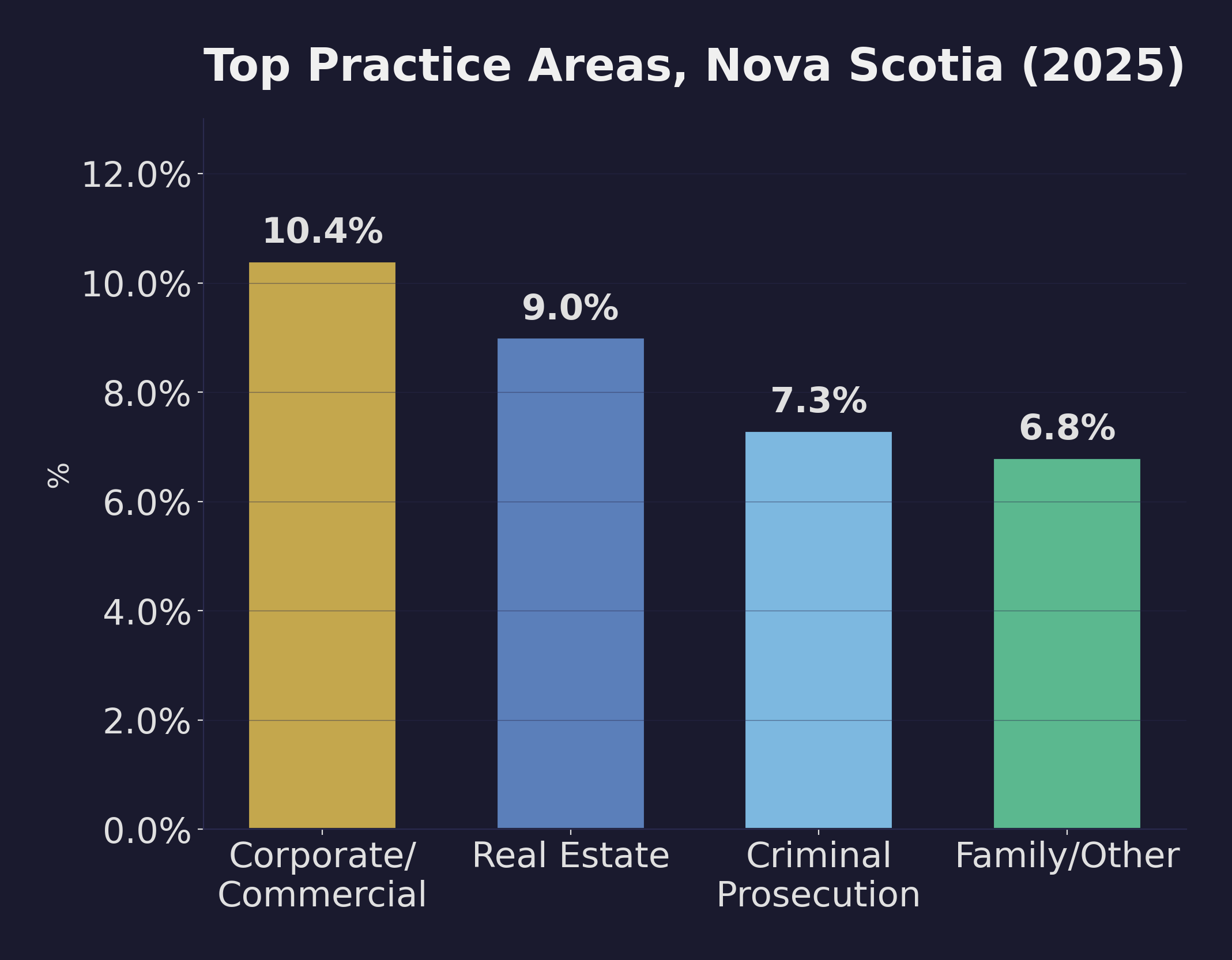
Those numbers have direct marketing implications. Areas with the densest practitioner count face the toughest organic competition. Areas showing year-over-year growth open the widest windows for firms willing to build targeted content now, before competitors catch up.
Practice Areas We Market in Halifax
- Personal injury - Motor vehicle collisions on Highway 102, Highway 103, the Bedford Highway, and the Angus L. Macdonald and A. Murray MacKay harbour bridges. Slip and falls, medical malpractice, and long-term disability denials. Maritime and offshore workplace injuries tied to Irving Shipbuilding, the Halifax Shipyard, and the port. Personal injury sits at the top of the per-file value scale in any Canadian market, and the highway geography running through HRM keeps the underlying case volume steady.
- Family law - Divorce, parenting time, decision-making responsibility, child and spousal support, and property division under the Parenting and Support Act and the Family Property Act. HRM's rapid demographic expansion drives consistent demand. Family matters across the municipality concentrate at the Devonshire Avenue courthouse.
- Criminal defence - Provincial Court files on Spring Garden Road and at the Pleasant Street satellite in Dartmouth, with indictable offences elevated to the Supreme Court. Files span impaired driving, domestic violence, assault, and drug offences, with a growing share of administration-of-justice charges.
- Real estate law - Residential closings, commercial transactions, and condominium work under the Halifax Regional Municipality Charter and the Land Registration Act. HRM's housing market has absorbed one of the largest waves of interprovincial migration in the country, keeping the closing calendar full on both the buyer and seller sides.
- Immigration law - Work permits, permanent residence applications, and citizenship filings. Nova Scotia has one of the most aggressive provincial nominee programs in the country, and the Atlantic Immigration Program continues to route newcomers through Halifax.
- Corporate and commercial - Business formation, shareholder agreements, commercial contracts, and commercial litigation. HRM's economy spans government, ocean industries, defence, financial services, and a growing technology sector.
- Employment law - Wrongful dismissal, constructive dismissal, employment contracts, occupational health and safety, and human rights matters. The public sector's weight inside HRM produces unionized files that are rare outside Atlantic Canadian capital cities.
- Wills and estates - Estate planning, powers of attorney, personal directives, estate administration, and contested estate litigation. Nova Scotia's aging demographic curve keeps the category in consistent intake growth.
Keywords Halifax Law Firms Should Target
SEO strategy begins with a defensible keyword map. Halifax is the dominant Atlantic Canadian market, but it is materially less saturated than Toronto, Vancouver, or Calgary. These are the terms worth building around:
- “personal injury lawyer Halifax”
- “car accident lawyer Halifax”
- “criminal defence lawyer Halifax”
- “family lawyer Halifax”
- “real estate lawyer Halifax”
Each practice area your firm handles deserves its own page targeting the relevant city. Dartmouth, Bedford, and Truro land even lower on the competition scale and convert at the same rate per visit, which makes them attractive secondary targets with dedicated pages. Google “near me” queries rank among the highest-volume legal searches nationally and depend on Google Business Profile strength, local citations, and review volume.
Long-tail queries matter too. “How much does a personal injury lawyer cost in Halifax” and “best family lawyer Halifax reviews” pull lower volume but convert at higher rates because they signal a searcher closer to hiring. For a broader framework on how to build a keyword map for a Canadian law firm, see our guide on why Canadian law firms need SEO.
Get Started with a Free Marketing Audit
We will review your website, search rankings, Google Business Profile, and competitor landscape, then deliver a clear report showing exactly where you stand and what to improve. No charge, no obligation.
Instant AI Readiness Check Get Your Free Full Audit
Frequently Asked Questions
What keywords should a Halifax law firm target?
Build around practice-area-plus-city pairs: "personal injury lawyer Halifax," "family lawyer Halifax," "criminal defence lawyer Halifax." Stand up a separate page for each practice area and each target city. If your firm serves Dartmouth, Bedford, or Truro, add city-specific pages for those markets too, because Google ranks them as distinct local ecosystems inside HRM.
How much does law firm marketing cost in Halifax?
Budgets vary with scope. Most Halifax firms running a full digital program land between $2,500 and $4,500 per month once SEO, content, and Google Business Profile management are bundled. An SEO-only retainer typically runs $1,500 to $3,000 per month. New websites fall in the $3,000 to $10,000 range for most small and mid-sized firms. Nova Scotia is one of the most affordable legal-marketing provinces in the country, with pricing roughly 25 to 35% below the Toronto equivalent.
How long does it take for SEO to work for a Halifax law firm?
Expect measurable movement inside three to six months for competitive areas like personal injury, criminal defence, and family law. Less saturated areas such as wills and estates, real estate, or immigration can show ranking gains inside eight to twelve weeks. Halifax's thinner search competition relative to Toronto or Vancouver compresses the timeline compared to the big metros.
Should Dartmouth and Bedford firms target Halifax keywords too?
Yes. All three sit inside Halifax Regional Municipality, and many HRM residents use "Halifax" as a shorthand regardless of their postal code. A Dartmouth or Bedford firm should target both its own city name and Halifax at the keyword level to pick up the full breadth of the catchment.
Is immigration law worth marketing for in Halifax?
Yes. Nova Scotia runs one of the most active provincial nominee programs in the country, the Atlantic Immigration Program channels substantial newcomer volume through Halifax, and Dalhousie and Saint Mary's University international students generate ongoing demand for work permit and post-graduation filings. Immigration is one of the faster-growing practice areas in HRM, and dedicated pages targeting "immigration lawyer Halifax" and "work permit lawyer Nova Scotia" will earn intake over time.
Do Halifax personal injury lawyers need SEO?
Personal injury is the most competitive and highest-value practice area in any Canadian legal market, and HRM is no exception. Highway 102 and Highway 103 carry major commuter and interurban traffic, and the Macdonald and MacKay bridges move tens of thousands of vehicles between Halifax and Dartmouth every day. A Halifax PI firm missing from page one for "personal injury lawyer Halifax" or "car accident lawyer Halifax" is handing intake directly to the firms that did invest in search.