We plan, write, and publish legal content that ranks in search and converts readers into signed cases. This page covers what we write, how we measure results, and what sets our approach apart.
Table of Contents
- Traffic Without Cases Is Meaningless
- What We Write
- How We Approach Content Marketing
- Content Marketing vs. Other Channels
- Why Content Marketing Matters More Now
- Our Approach
- Outcomes We Actually Measure
- What Sets Us Apart
- The Numbers
- Ready to Talk About Content?
- Frequently Asked Questions
Traffic Without Cases Is Meaningless
Forty-two percent of Canadians discover legal services through search engines (Department of Justice Canada, Pathways to Justice, 2023). That number keeps rising. When someone searches "what to do after a car accident in Ontario" or "how to file for divorce in Calgary," the law firm that published a clear, authoritative answer to that question gets the call.

Most legal content never does. Most legal SEO is templated. Most law firm blogs get ignored by Google, by readers, and by the people who should have called. Traffic charts climb, consultations do not, and the firm keeps paying.
One-third of law firms have a blog (ABA TechReport, 2023). Most of those blogs contain a handful of posts written three years ago, covering topics nobody searched for, in a voice that reads like a textbook. That is not content marketing. That is a checkbox someone ticked during a website redesign.
Generic content does not convert. Content works when it is strategic: published consistently, targeted at the queries your potential clients actually search, written well enough to earn trust, and tied to a specific practice area and retainer value. That last part is the difference between content that entertains and content that funds a practice.
What We Write
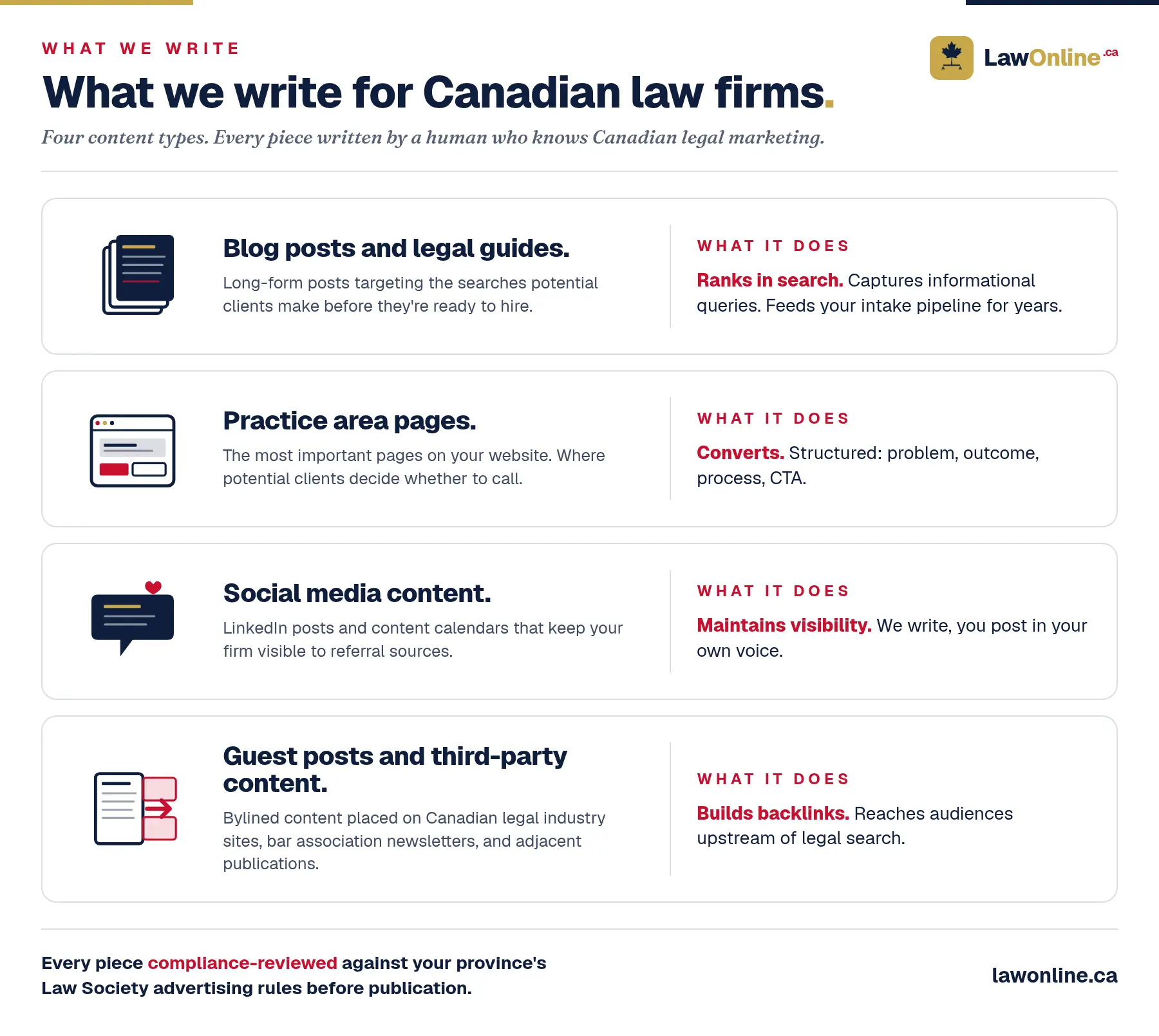
We produce every type of written content a law firm needs to attract and convert clients online. Each piece is written by humans who understand Canadian law, legal terminology, and the nuances of marketing within Law Society advertising rules.
Blog Posts and Legal Guides
Blog posts are the engine of legal content marketing. They target the informational searches potential clients make before they're ready to hire a lawyer. A personal injury firm that publishes a detailed guide on accident benefits in Ontario will rank for dozens of related search terms and generate a steady stream of inquiries from people who need exactly that expertise.
Topic selection starts with data. We pull your Google Search Console queries, identify what potential clients are already searching to find firms like yours, and cross-reference those terms against the competitive landscape. If your PI firm is showing impressions for "what to do after a hit and run in Ontario" but isn't ranking on page one, that's a blog post waiting to be written. We prioritize topics by search volume, conversion potential, and the retainer value of the practice area they serve.
Every post goes through a structured workflow: research and keyword targeting, drafting by a writer who understands Canadian legal concepts, editorial review for accuracy and readability, and a compliance check against provincial Law Society advertising rules. That last step isn't optional. A personal injury blog post that makes unverifiable claims about case outcomes doesn't just violate professional conduct rules; it erodes the trust you're trying to build.
We also plan posts in clusters, not isolation. A single article on car accident claims performs well. A cluster of posts covering accident benefits, fault determination, limitation periods, and settlement timelines dominates the search results for that entire topic area. For a deeper look at what types of content work best, see our guide to the types of content law firms need.
Practice Area Pages
Your practice area pages are the most important pages on your website. They describe what you do, who you help, and why someone should choose your firm. They also need to rank for competitive keywords like "personal injury lawyer Toronto" or "family law firm Calgary."
Most law firm practice area pages are thin. A paragraph or two, copied from a template. That's not enough.
We write practice area pages that follow a structure proven to convert: start with the problem your client is facing, move to the outcome they want, walk through the process of working with your firm, and close with a clear call to action. For a motor vehicle accident page, that means opening with the reality of dealing with insurance adjusters and mounting medical bills, then explaining what an experienced PI lawyer actually does to change that situation. For a family law page covering child custody, it means acknowledging the fear and uncertainty a parent feels, then outlining how custody arrangements work under Canadian law and what the firm does to protect their interests.
This structure works because it mirrors how potential clients think. They don't arrive at your website looking for a legal encyclopedia. They arrive with a problem, and they want to know if you understand it and can solve it.
At least half of our practice area examples centre on personal injury, because PI firms face the most competitive search landscape and the highest cost per click in paid channels. Strong organic practice area pages are the best long-term counterweight to that spend.
Social Media Content
Social media for law firms isn't about going viral. It's about maintaining visibility with referral sources, past clients, and your local professional community. We handle the planning and writing side: drafting LinkedIn posts that position your lawyers as knowledgeable, approachable experts, creating content calendars that keep publishing consistent, and adapting blog content into social-friendly formats. For a full breakdown of how social media fits into legal marketing, read our social media marketing guide.
We don't manage posting or community engagement directly. Your firm's voice is your own, and social interactions work best when they come from the lawyers themselves. What we do is make sure there's always something worth posting, written in a tone that fits the platform and your firm's personality.
Guest Posts and Third-Party Content
Publishing on third-party platforms builds backlinks to your website (a direct ranking factor) and puts your firm's name in front of audiences you wouldn't reach through your own channels.
We handle the full process: identifying target publications (Canadian legal industry sites, provincial bar association newsletters, legal technology platforms, and relevant business publications), pitching topics that editors actually want to run, writing the content, and managing the editorial back-and-forth through to publication. The goal is placement on sites that carry genuine authority in the legal space, not link farms or generic directories.
For personal injury firms, guest content on publications covering insurance, healthcare, or accident prevention reaches potential clients upstream, before they've started searching for a lawyer. For firms in other practice areas, we target publications relevant to their client base. The backlinks strengthen your site's domain authority, and the bylined content builds your lawyers' professional reputation beyond your own website.
How We Approach Content Marketing
Our process has six stages. Each one exists because skipping it produces content that either doesn't rank, doesn't convert, or creates compliance risk.
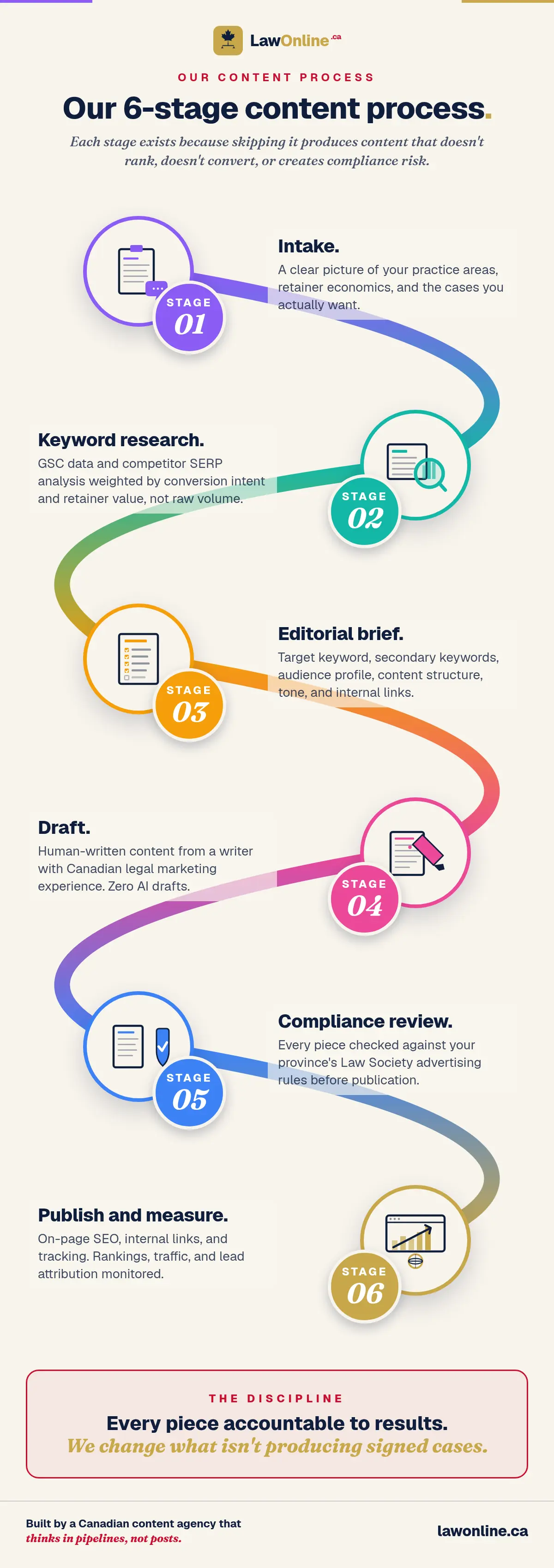
- Intake. We start by learning your firm: practice areas, target case types, retainer economics, geographic focus, and the kinds of clients you want more of. A personal injury firm chasing catastrophic injury cases in Hamilton has completely different content needs than a family law practice in Ottawa focused on high-net-worth divorces.
- Keyword research. We pull data from Google Search Console (if you have it), run competitor SERP analysis, and identify the searches your potential clients are making right now. We don't just look at volume. We weight keywords by conversion intent and the retainer value of the practice area they feed.
- Editorial brief. Every piece of content gets a brief before writing starts: target keyword, secondary keywords, audience profile, content structure, tone guidelines, and internal links. This is where the strategy becomes specific.
- Draft. A human writer with Canadian legal marketing experience produces the content. We don't use AI-generated drafts. The writing needs to demonstrate genuine understanding of the legal concepts it covers, and that requires a writer who's spent real time learning how Canadian law firms work.
- Compliance review. Every piece is checked against the relevant provincial Law Society advertising rules before it goes live. In Ontario, that means Rules of Professional Conduct requirements around accuracy and verifiability. In Alberta, stricter rules around specialization claims. We catch these issues before publication, not after.
- Publish and measure. Content goes live with proper on-page SEO, internal linking, and tracking in place. We monitor ranking performance, organic traffic, and lead attribution so every piece of content is accountable to results.
Content Marketing vs. Other Channels
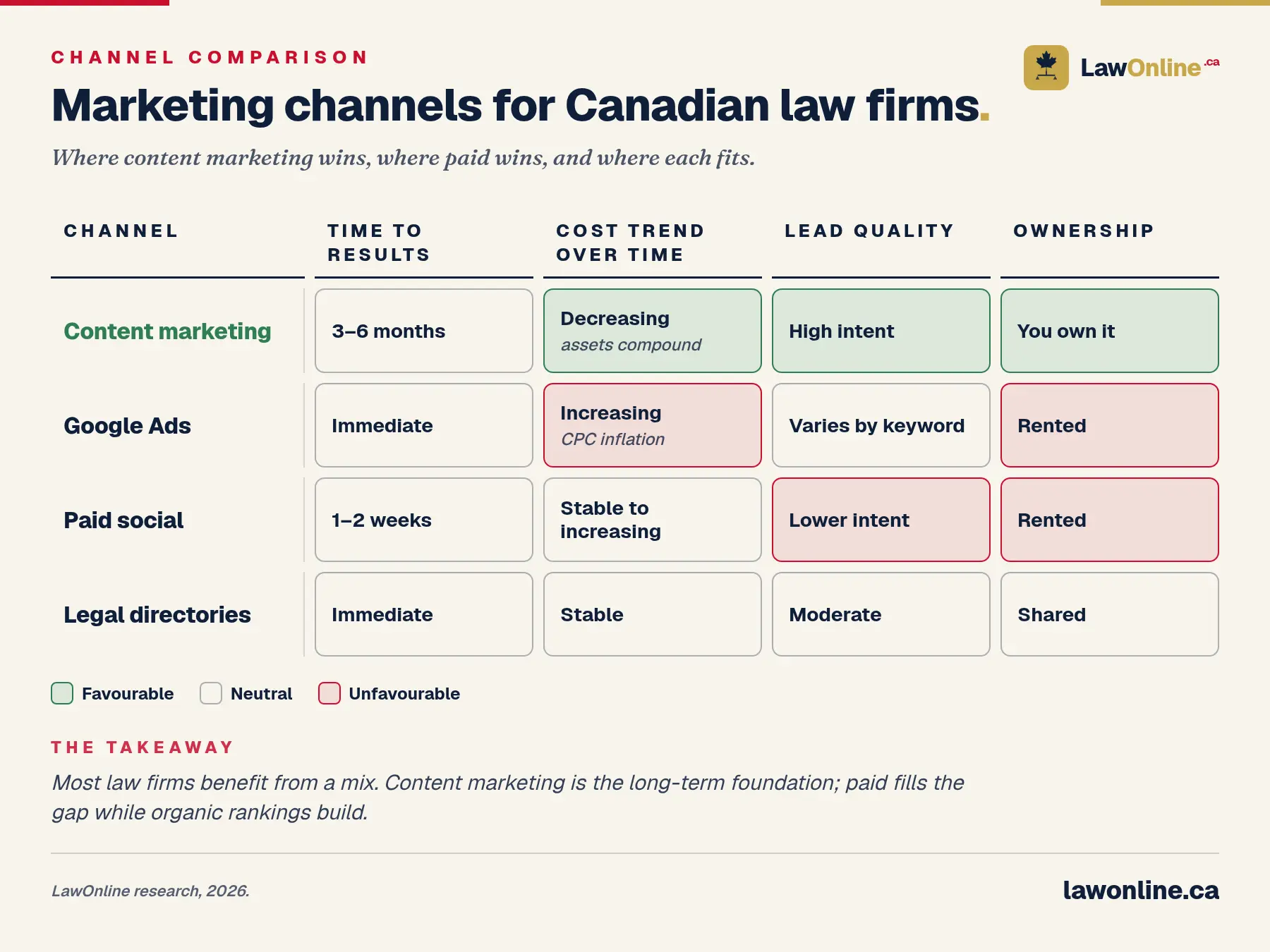
Content marketing isn't the only way to generate leads for a law firm. It competes for budget with Google Ads, paid social, and legal directories. Here's how they compare.
Content marketing vs. Google Ads. PPC delivers leads immediately, but the cost per click for legal keywords in Canada is steep. Personal injury terms routinely exceed $50 per click, and the leads stop the moment you pause the campaign. Content marketing takes longer to produce results (typically three to six months), but the returns compound. A blog post that ranks for "what to do after a slip and fall in Ontario" generates traffic for years without additional spend.
Content marketing vs. paid social. LinkedIn and Facebook ads can build awareness, but legal services aren't impulse purchases. Social ads work better for brand visibility than for direct lead generation. Content marketing targets people who are actively searching for legal help, which means higher intent and better lead quality.
Content marketing vs. legal directories. Directories like FindLaw, CanLaw, and Lawyer.ca provide visibility, but you're competing for attention alongside every other firm that paid for a listing. Your own content, on your own website, builds authority that belongs to you and compounds over time.
| Channel | Time to Results | Cost Trend Over Time | Lead Quality | Ownership |
|---|---|---|---|---|
| Content marketing | 3-6 months | Decreasing (assets compound) | High intent | You own it |
| Google Ads | Immediate | Increasing (CPC inflation) | Varies by keyword | Rented |
| Paid social | 1-2 weeks | Stable to increasing | Lower intent | Rented |
| Legal directories | Immediate | Stable | Moderate | Shared |
See the visual infographic version of this comparison. [Opens in lightbox]
For most law firms, the best approach is a mix, with content marketing as the long-term foundation and paid channels filling the gap while organic rankings build. For PI firms facing $50+ CPCs, shifting budget toward content is particularly compelling.
Why Content Marketing Matters More Now
Google's search results have changed. AI overviews, featured snippets, and "People Also Ask" boxes increasingly dominate the top of the page. The firms that appear in these results are the ones publishing comprehensive, well-structured content that directly answers specific questions. Content marketing is one pillar of a complete law firm SEO strategy.
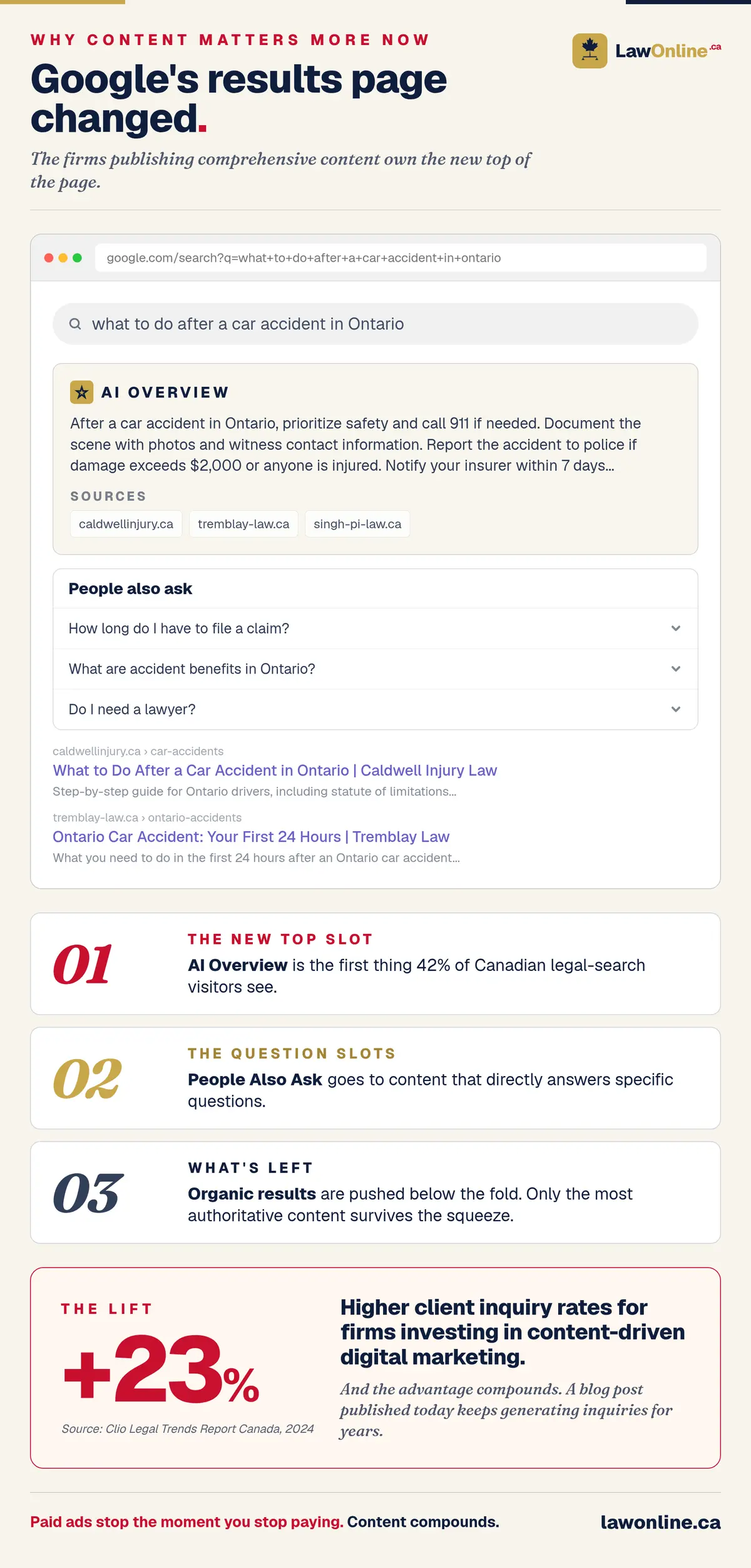
Firms investing in content-driven digital marketing see 23% higher client inquiry rates (Clio Legal Trends Report Canada, 2024). That advantage compounds. A blog post published today continues generating traffic and inquiries for years. Paid ads stop working the moment you stop paying.
For personal injury firms in particular, content marketing is one of the few channels that can compete with the massive PPC budgets of larger competitors. You cannot outspend a national firm on Google Ads. You can outwrite them.
Our Approach
We Start with Research
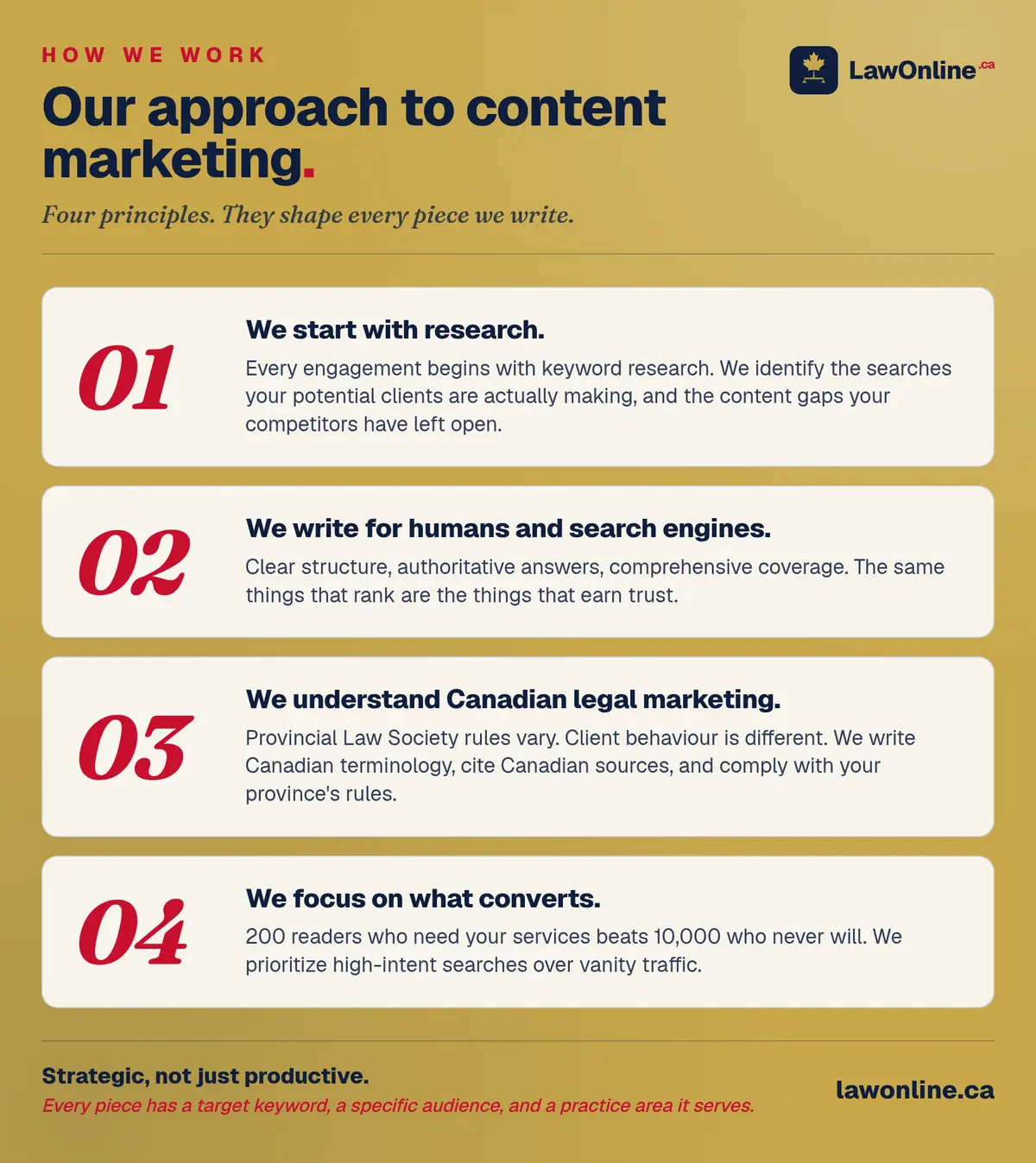
Every engagement begins with keyword research. We identify the specific searches your potential clients make, the competitive landscape for those terms, and the content gaps your competitors have left open. This research shapes every piece of content we produce.
We Write for Humans and Search Engines
Search engine optimization and good writing are not at odds. The same qualities that make content rank well (clear structure, authoritative answers, comprehensive coverage) are the qualities that make a reader trust your firm. We do not stuff keywords or write for algorithms. We write clearly about legal topics, then ensure the technical SEO elements are in place. Google calls this E-E-A-T: experience, expertise, authoritativeness, and trustworthiness. Because law is a YMYL (Your Money or Your Life) topic, E-E-A-T standards are significantly higher for legal content.
We Understand Canadian Legal Marketing
The Canadian legal market is different from the American market. Provincial Law Society advertising rules vary. The competitive landscape is different. Client behaviour is different. We write content that reflects Canadian legal terminology, cites Canadian sources, and complies with the advertising rules of your province.
In Ontario, the Law Society's Rules of Professional Conduct require that all marketing be true, accurate, and verifiable. In Alberta, the rules are stricter about claims of specialization. We know these differences and write accordingly.
We Focus on What Converts
Not all traffic is valuable. A blog post that attracts 10,000 readers who will never hire a lawyer is less valuable than one that attracts 200 readers who need your specific services. We prioritize content that targets high-intent searches: the queries people make when they have a legal problem and are looking for help.
For a personal injury firm, that means content about what to do after an accident, how accident benefits work, and what to expect from the claims process. For a family law firm, it means guides on separation agreements, child custody, and property division. The specifics vary by practice area, but the principle is the same: write for the people who need a lawyer, not for a general audience.
Outcomes We Actually Measure
Most legal content reports rank traffic and keyword positions, then call it a day. We report on the numbers that determine whether your marketing is a cost centre or a profit centre.
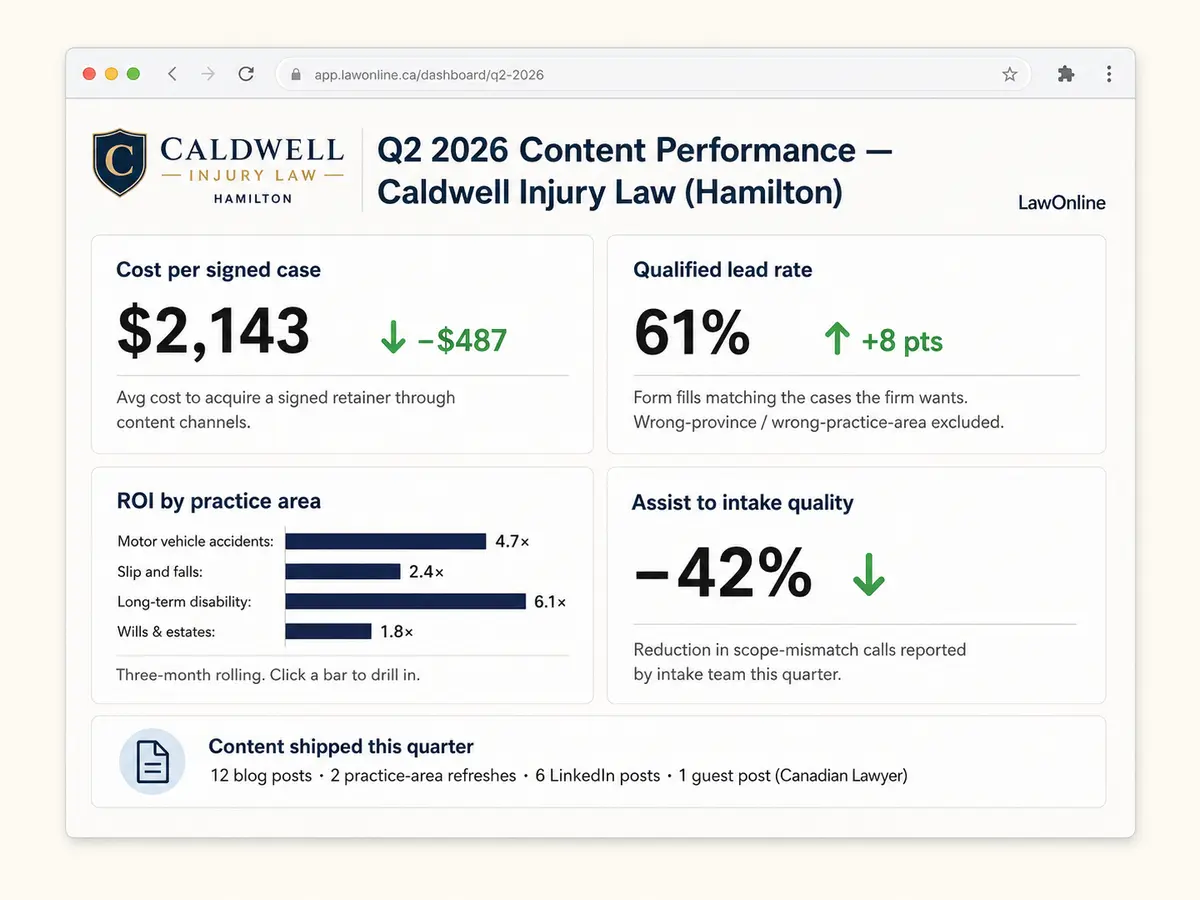
Cost per signed case. Every piece of content we publish is traced back to the consultations and retainers it generated. For a personal injury firm, a single signed motor-vehicle-accident file can justify a year of content spend. We plan content with that math in mind, not with a traffic target.
Qualified lead rate. A consultation request from someone outside your service area or outside your practice area is not a win. We track the percentage of form fills that match the cases your firm actually wants, then tune the content plan to raise that number.
ROI by practice area. A family law firm that also handles wills and estates has different retainer economics on each side of the practice. We break performance out by practice area so you can see which content is funding the practice and which is not, and shift spend accordingly.
Assist to intake quality. Content shapes what readers expect before they ever reach your intake team. Clear practice area explanations, honest fee discussions, and realistic scope guidance reduce the friction your intake team feels on the first call. Your web design and intake systems do the heavy lifting on conversion, but content either sets up a qualified conversation or wastes everyone's time.
What Sets Us Apart
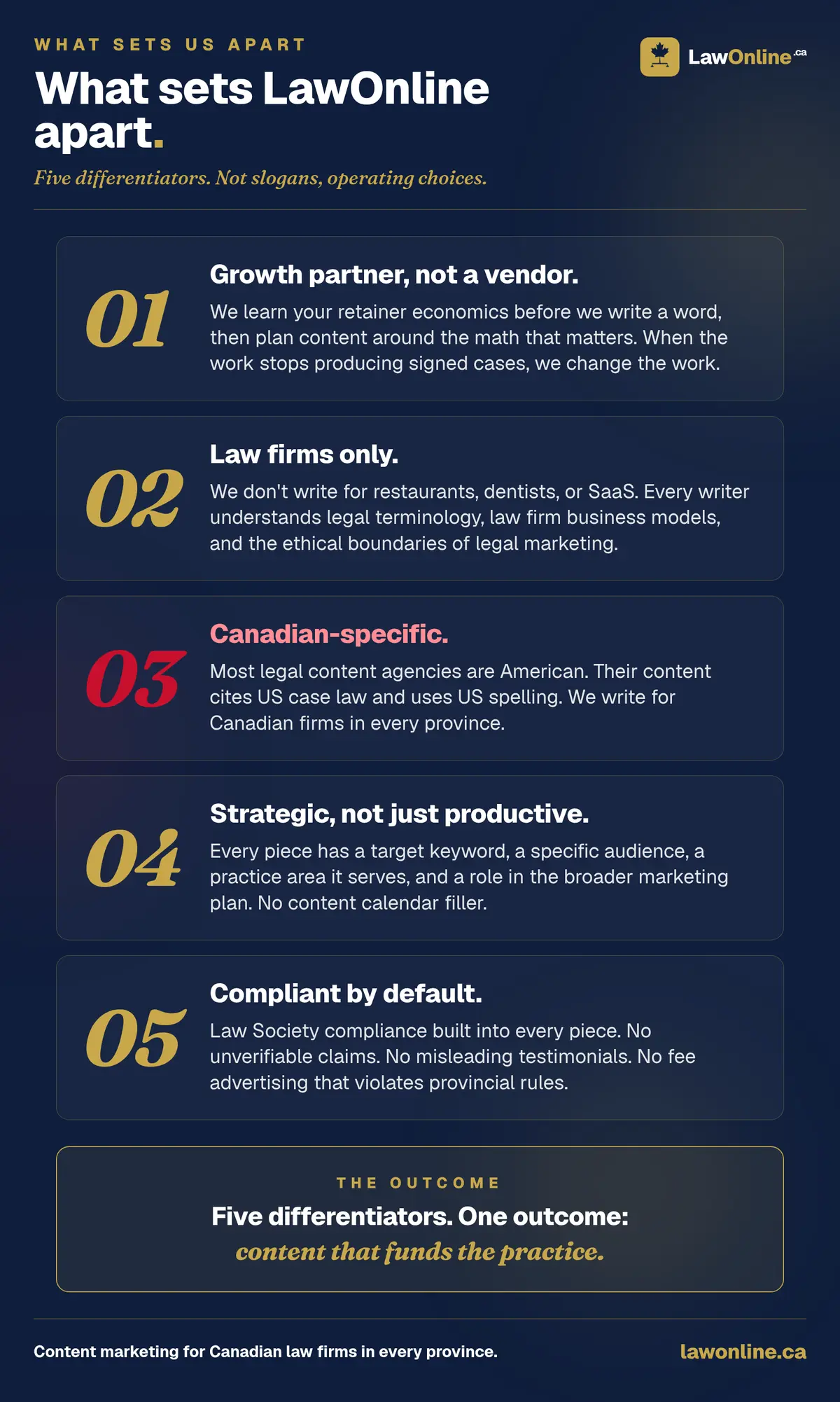
Growth partner, not a vendor. Most agencies treat legal content as a production line: churn out blog posts, ship a rank report, move on. We work differently. We learn your practice areas, your retainer economics, and the kinds of cases you actually want before we write a word, then plan content around the math that matters to your firm. When the work stops producing signed cases, we change the work.
Law firms only. We do not write content for restaurants, dentists, or SaaS companies. Every writer on our team understands legal terminology, law firm business models, and the ethical boundaries of legal marketing.
Canadian-specific. Most legal content marketing agencies are based in the United States. Their content cites American case law, references American statutes, and uses American spelling. We write for Canadian firms in Ottawa, Vancouver, and across every province, cite Canadian sources, and understand the provincial regulatory landscape.
Strategic, not just productive. We do not churn out blog posts to fill a content calendar. Every piece of content has a purpose: a target keyword, a specific audience, a practice area it serves, and a role in your overall marketing strategy.
Compliant by default. We build Law Society compliance into every piece of content. No unverifiable claims. No misleading testimonials. No fee advertising that violates provincial rules.
The Numbers
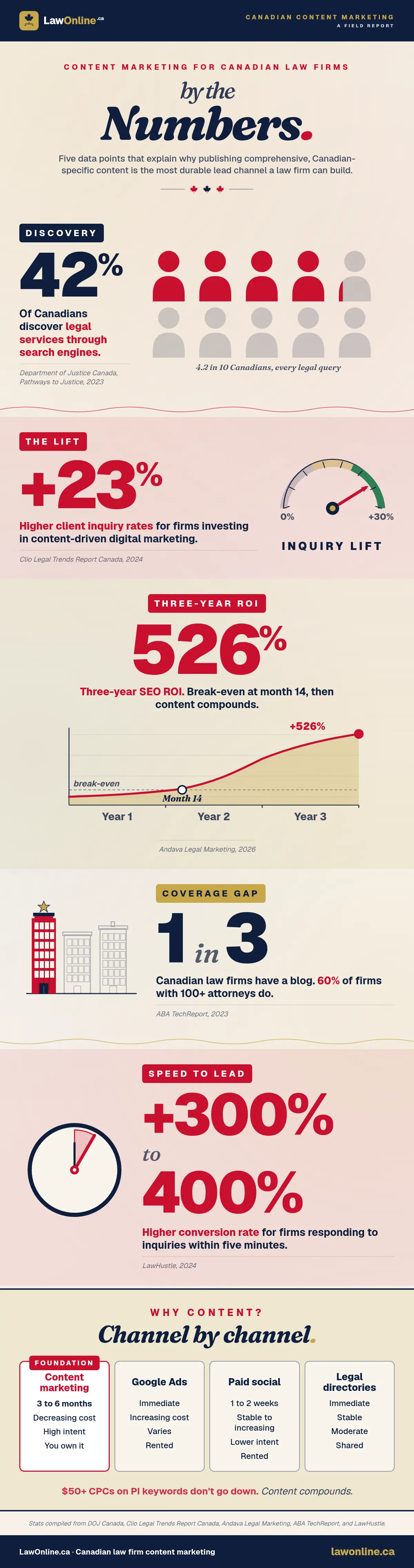
- 42% of Canadians discover legal services via search engines (DOJ Pathways to Justice, 2023)
- Firms investing in content-driven digital marketing see 23% higher client inquiry rates (Clio Legal Trends Report Canada, 2024)
- SEO delivers 526% ROI over three years, breaking even at 14 months (Andava Legal Marketing, 2026)
- One-third of law firms have a blog; 60% of firms with 100+ attorneys (ABA TechReport, 2023)
- Firms responding to inquiries within five minutes achieve 300-400% higher conversion rates (LawHustle, 2024)
Ready to Talk About Content?
If your firm's website is not generating the inquiries it should, content is almost always part of the answer. We will review your current content, identify the gaps, and show you exactly what a strategic content plan looks like for your practice areas and market. Framed around cost per signed case and ROI by practice area, not vanity metrics.
This is a strategic conversation, not a sales pitch. No obligation, no pressure.
Frequently Asked Questions
What is content marketing for law firms?
Content marketing for law firms (also called content marketing for lawyers or legal content marketing) is the practice of creating and publishing written content (blog posts, practice area pages, guides, and articles) that attracts potential clients through search engines and builds enough trust to convert them into consultations. It's different from traditional advertising because the content itself is useful to the reader. A personal injury firm that publishes a detailed guide on what to do after a car accident in Ontario isn't running an ad. It's answering the exact question someone with a legal problem is searching for. When that content ranks in Google, it generates qualified inquiries from people who already trust the firm before they pick up the phone.
How much does law firm content marketing cost?
Pricing depends on the scope. A single blog post costs less than an ongoing monthly content program that includes blog posts, practice area pages, and social media content. During our initial consultation, we scope your needs and provide transparent pricing before any work begins. For a broader look at legal marketing pricing in Canada, see our guide to law firm marketing costs.
How often should a law firm publish blog posts?
Consistency matters more than frequency. One well-researched, well-written post per month outperforms four thin posts that nobody reads. For most firms, two to four posts per month is the range where content marketing starts generating measurable results.
Can I write my own law firm blog posts?
You can, and some lawyers do it well. The challenge is time and consistency. Content marketing only works if you publish regularly and optimize for search. Most lawyers find that the hours spent writing and researching SEO would be better spent practising law. Our content marketing starter guide covers what works if you want to try it yourself.
How long does it take for content marketing to show results?
Content marketing is a long-term investment. Most firms begin seeing measurable improvements in search rankings within three to six months, with significant traffic growth between six and twelve months. Unlike paid ads, the results compound over time. A post published today can generate inquiries for years.
Will the content comply with Law Society advertising rules?
Yes. We write every piece of content with provincial Law Society advertising rules in mind. We do not make unverifiable claims, we do not use misleading testimonials, and we ensure fee advertising meets provincial standards for clarity and completeness. Read our Ontario advertising rules guide for details.
What does a content marketing agency do for a law firm?
A content marketing agency for lawyers handles the strategy, research, writing, and optimization that most law firms don't have time to do in-house. That includes keyword research to find the searches your potential clients are making, editorial planning to ensure content targets the right practice areas and case types, writing by people who understand Canadian legal concepts and Law Society advertising rules, and ongoing measurement to track which content is generating consultations and signed cases. The goal isn't more content for its own sake. It's content that produces a measurable return on the firm's marketing investment.
Is AI-generated content bad for law firm SEO?
Google doesn't penalize content for being AI-generated. It penalizes content for being unhelpful, inaccurate, or thin, regardless of how it was produced. The problem with AI-generated legal content specifically is accuracy and trust. Large language models produce plausible-sounding text, but they regularly fabricate case citations, confuse provincial and federal law, and generate advice that would violate Law Society advertising rules. For a personal injury firm, a blog post that misstates how accident benefits work in Ontario doesn't just rank poorly. It erodes the trust that content marketing is supposed to build. Effective attorney content marketing depends on readers trusting what you publish, and AI-generated text undermines that trust the moment a reader spots an error. We use human writers who understand the legal concepts they're writing about, because the stakes of getting it wrong are too high.
What is E-E-A-T and how does it apply to law firm content?
E-E-A-T stands for Experience, Expertise, Authoritativeness, and Trustworthiness. It's the framework Google's quality raters use to evaluate whether content deserves to rank highly. For law firms, E-E-A-T matters more than it does for most industries because legal content falls under Google's "Your Money or Your Life" (YMYL) category, where inaccurate information can cause real harm. Demonstrating E-E-A-T means publishing content written by people with genuine legal marketing expertise, citing Canadian legal sources, maintaining factual accuracy, and building the kind of backlink profile and online presence that signals authority. A personal injury firm with detailed, accurate content about the claims process, authored by professionals who understand Ontario tort law, satisfies E-E-A-T in a way that generic AI-generated articles never will. For a practical breakdown of each pillar with an audit checklist, see our guide to E-E-A-T and YMYL for law firms.
What is legal copywriting?
Legal copywriting (also called law firm copywriting) is writing persuasive, conversion-focused content for law firms. It's distinct from legal writing (drafting contracts, factums, or memos) and from general marketing copywriting (which doesn't account for Law Society advertising rules or legal terminology). Good legal copywriting explains complex legal concepts in plain language, builds trust with potential clients, and moves readers toward a consultation, all while staying compliant with provincial advertising regulations. Practice area pages, landing pages, and calls to action all fall under legal copywriting. For a PI firm, that means writing about motor vehicle accidents, slip and falls, and long-term disability claims in a way that's clear, accurate, and compelling enough that someone dealing with those issues picks your firm over the next search result.
How long should a law firm blog post be?
There's no universal answer, but most high-performing legal blog posts fall between 1,200 and 2,500 words. The right length depends on the topic and the competition. A post answering "how long do I have to file a personal injury claim in Ontario?" can cover limitation periods thoroughly in 1,200 words. A comprehensive guide to the accident benefits system might need 2,500. What matters more than word count is completeness. Google ranks content that fully answers the searcher's question. If a competing article covers the topic in 2,000 words and yours covers it in 800, you'll struggle to outrank it. We research the competitive landscape for each target keyword and write to the depth the topic requires.
What is a practice area page and how do you write one?
A practice area page is the primary page on a law firm's website for a specific area of law: personal injury, family law, criminal defence, immigration, employment law. It's where potential clients land when they search for a lawyer in that practice area, and it's where they decide whether to contact your firm. Effective practice area pages follow a structure: lead with the problem (a car accident, a custody dispute, a wrongful dismissal), describe the outcome the client wants (fair compensation, a parenting arrangement, reinstatement), explain the process of working with your firm, and close with a clear call to action. Pages built this way convert better than generic descriptions because they demonstrate that you understand the client's situation before they've even called.
How does content marketing compare to Google Ads for law firms?
Both channels generate leads, but they work on different timelines and cost structures. Google Ads delivers results immediately. You set a budget, bid on keywords like "personal injury lawyer Toronto," and your ad appears at the top of search results. The downside is cost: legal keywords in Canada often exceed $50 per click, and the traffic stops the moment you pause the campaign. Content marketing takes three to six months to start generating significant organic traffic, but the results compound. A blog post that ranks for a high-intent keyword generates inquiries month after month without additional spend. For PI firms facing $50+ CPCs, content marketing is one of the few realistic ways to compete with larger firms' ad budgets over the long term. Most firms benefit from running both channels, using paid ads for immediate lead generation while content marketing builds the organic foundation.