
We run website design, SEO, Google Business Profile management, and content programs for law firms across Toronto and the GTA. This page covers our approach to Canada’s most competitive legal search market, including services, pricing, keywords, and how to get started.
Table of Contents
- Why Toronto and GTA Law Firms Need a Marketing Strategy
- Services for Toronto and GTA Law Firms
- Law Firm Web Design in Toronto and the GTA
- Why Most Law Firm SEO Fails
- The Toronto and GTA Legal Market
- Ontario's Legal Profession by the Numbers
- Toronto's Legal Education Pipeline
- The Courts
- Toronto Court Caseload: Why Online Visibility Matters
- How Much Does Law Firm Marketing Cost in Toronto?
- Practice Areas We Market in Toronto and the GTA
- Keywords Toronto and GTA Law Firms Should Target
- Get Started with a Free Marketing Audit
- Frequently Asked Questions
Why Toronto and GTA Law Firms Need a Marketing Strategy
The GTA is the most contested legal search market in Canada and, by any objective measure, in a league of its own. More than 6.2 million people live inside the Toronto CMA. Thousands of them open a browser on any given Tuesday and type a practice area paired with a city name. Hundreds of firms chase those clicks.
Plenty of those firms operate a website. A large share have run at least one SEO engagement. A surprising number still cannot be found on the first page for a single keyword that matters.
Two causes sit behind most of that. First, the firm retained a generalist shop that markets auto dealerships, dentists, and restaurants interchangeably and treats law firms as another vertical. Second, the firm bought SEO that pumped out traffic graphs without ever moving signed files up the ledger. Rankings untethered from retainers are a bookkeeping exercise, not a marketing program. Traffic that does not convert into consultations is decoration.
LawOnline.ca is the specialist alternative. Canadian law firms are the only clientele we accept, and every campaign is built around Law Society of Ontario advertising expectations, the search dynamics of the densest legal market in the country, and the practical difference between a visitor who scrolled past and a caller who books the intake call.
Services for Toronto and GTA Law Firms
Website Design for Toronto Law Firms
Law firm website design in Toronto starts with a constraint that does not exist in most other markets: every competitor on the first page has already invested heavily in performance, structure, and conversion. A downtown firm cannot afford a site that loads like it was designed for a fax machine. In a market where competitors bid six figures annually on the same keywords, every second a page takes to render is a retainer handed to somebody else.
Speed, ranking, and conversion drive every build. Legal-vertical structured data is coded in from the first commit, WCAG 2.1 AA accessibility is treated as baseline behaviour rather than a nice-to-have, mobile-first layouts scale up instead of collapsing down, and the call-to-action sits above the fold on every screen that matters. Pages paint in under two seconds whether a prospect is reading from a subway platform at St. George, a coffee shop on Queen West, or a home office in Mississauga. None of that is aesthetic preference. Google feeds page-speed and interaction metrics directly into how it ranks law firm sites across the GTA.
Search Engine Optimization (SEO) for GTA Law Firms
Firms pursuing law firm SEO in Toronto are competing in the most demanding legal search market in Canada. Ranking inside it takes a real program, not a templated content calendar and a few directory submissions. Our retainer runs both halves of the discipline in parallel: the engineering work (technical audits, Core Web Vitals remediation, crawl budget management, schema architecture, internal link topology) and the editorial work (intent-mapped practice-area pages, keyword plans aligned to how Torontonians actually phrase their searches, and assets solid enough to earn citations from credible Canadian outlets).
Original content is non-negotiable here. Keyword-stuffed filler and recycled American blog posts have zero chance of ranking against the established Toronto field. There are no shortcuts in this market that outlast a Google update, and the firms that sit atop the results are the ones that invested steadily for years rather than chasing quarterly quick wins.
Google Business Profile Optimization
When a Torontonian searches "lawyer near me" or pairs a practice area with a municipality, Google drops a three-pack map above every blue link on the results page. Whichever firms occupy those three slots collect the bulk of the first clicks for that query.
Our team manages every control surface the listing exposes. That includes verified name, address, and phone data synced across every major directory, primary and secondary category choices calibrated to the practice areas the firm wants to grow, service-area polygons that match the actual client catchment, booking links pointed at the firm's intake platform, updated photography on a rolling schedule, weekly posts, and a review-gathering workflow benchmarked against Rule 4.2 of the LSO advertising rules. A Google Business Profile is tied to a single verified address. A firm with offices in Toronto, Mississauga, Markham, and Scarborough therefore needs four separate profiles, four dedicated optimization plans, and four city-level landing pages, because Google scores each municipality as its own local competitive index. Merging them into one listing is one of the fastest ways to flatten visibility across the whole footprint.
Content Writing and Content Marketing for Toronto Law Firms
Content marketing for law firms in the GTA depends on one thing generalist agencies cannot replicate: command of Canadian law. Legal content marketing here means citing CanLII before outlining a page, referencing Ontario statutes, and writing to an audience that knows the difference between an American personal injury framework and the accident benefits regime under Ontario's Insurance Act.
Blog posts full of American terminology and generic advice do nothing for a Canadian law firm. Neither does AI-generated filler meant to hit a word count. Our writers are Canadians who pull the applicable statutes from CanLII before outlining a page. Frequently-referenced sources include Ontario's Insurance Act and the auto accident benefits schedule for PI work, the Family Law Act and the Children's Law Reform Act for family matters, the Criminal Code and Ontario Evidence Act on the criminal side, and municipal planning statutes whenever residential or commercial real estate is in play. Every draft clears an LSO advertising review before it ships to the firm, and nothing goes out under a lawyer's byline without that compliance check on record.
Website Migrations and Hosting
If your firm is stuck paying rent on an overpriced proprietary CMS, locked into an agency contract that holds your source code hostage, or slowly losing rankings to a WordPress stack that never gets maintained, we move the site end to end. The workflow starts with a complete URL inventory pulled from Google Search Console plus server logs, continues with a 301 redirect map tested in staging before any public cutover, synchronizes DNS and email routing with the firm's IT team, and watches keyword positions daily through the first weeks post-launch. The goal is simple: the organic authority your firm spent years building does not leak out during the migration.
Law Firm Web Design in Toronto and the GTA
Toronto is the most competitive legal market in Canada, and the web reflects it. Personal injury firms in the GTA compete against national franchises, boutique partnerships, and well-funded solo practices for the same high-intent search terms. A Toronto law firm's website isn't just a brochure. It's the primary tool that determines whether a potential client calls your firm or the one listed below you.
What makes web design for Toronto law firms different is the density of competition at every level. A personal injury practice in Mississauga isn't just competing against other Mississauga firms. It's competing against firms in Brampton, Oakville, Hamilton, and downtown Toronto, all bidding on overlapping keywords and all visible to the same pool of searchers across the GTA.
That density means a generic website template won't cut it. Toronto law firms need pages built for specific suburbs and communities, each with content that speaks to local courts, local referral networks, and the practice areas that drive the most search volume in that area. A family law firm serving North York needs different location targeting than a commercial litigation firm on Bay Street.
We build Toronto law firm websites with this competitive reality in mind. Every site includes practice-area pages targeting the specific terms GTA searchers use, location pages for the suburbs and regions the firm actually serves, and conversion architecture designed around how Toronto clients research and contact lawyers. Page speed, mobile performance, and LSO advertising compliance are built into the foundation, not bolted on after launch. See our law firm web design page for the full scope of what that includes.
Why Most Law Firm SEO Fails
Before any Toronto firm hands money to an agency, it is worth understanding why most legal SEO campaigns in this market produce more reports than revenue. The failure patterns are consistent and they hit harder here than anywhere else in Canada.
Vanity metrics replace real measurement. A dashboard showing traffic up 40% year over year means nothing if the extra visitors are students, tire-kickers, or bots. Traffic is not revenue. Sessions are not retainers. An agency that cannot connect organic visibility to signed files is selling a report, not a result.
Templated strategies get copied across clients. Identical title tag formulas, identical blog topics, identical anchor-text profiles applied to every law firm from Etobicoke to Pickering. Google's algorithm recognized that pattern long ago and discounts it accordingly.
Neighbourhood-level dynamics get ignored. The competitive field facing a PI practice in Scarborough is not the same field a downtown Bay Street litigation firm contends with. A Markham family boutique needs a different intent map than a Mississauga practice targeting the same keyword set. Uniform campaigns cannot address that granularity.
Advertising compliance gets overlooked. The Law Society of Ontario enforces specific rules about how lawyers may advertise, and an agency that does not know those rules is quietly creating compliance exposure for the firm. Every piece of copy we ship is vetted against the current LSO marketing requirements before it reaches production.
Our work sidesteps all of those failure modes for one reason: law firms are the only clients we accept, and Canadian law firms are the only version we know how to serve. The rules, the market nuances, and the buying intent behind each search term are part of the operating knowledge, not the onboarding curriculum.
The Toronto and GTA Legal Market
The GTA is not simply the largest legal market in Canada. It sits in a tier of its own, and the numbers make the point.
- Scale. The Toronto CMA population clears 6.2 million. York Region adds another 1.2 million residents. Peel Region, covering Mississauga and Brampton, contributes 1.5 million. Durham Region, which includes Pickering, Oshawa, and Whitby, brings 700,000 more to the catchment. A firm with the right online presence can reasonably market to upwards of nine million people from one properly built website.
- Competitive depth. The raw count of firms pursuing the same keywords means organic visibility is harder to earn here, and easier to lose, than anywhere else in the country. National franchises, boutique partnerships, and solo practices all compete for identical search terms, and the paid-search floor routinely exceeds what mid-sized firms in other provinces budget for an entire retainer.
- Cross-municipal reach. A family partnership in Markham regularly draws clients from Richmond Hill, Vaughan, and Scarborough. A PI shop based in Mississauga routinely chases files originating anywhere along the 401 or 403 corridors. Digital presence has to reflect that geographic reality, because Google treats each municipality as an independent local market regardless of how neatly they stitch together on a commuter map.
- The Toronto Lawyers Association. Operating since 1885 and serving over 3,000 members, the TLA sits at the centre of the city's continuing professional development, networking, and practice-support infrastructure for lawyers whose practice is rooted in Toronto.
Ontario's Legal Profession by the Numbers
Ontario holds not just the country's largest legal market but a disproportionate slice of the entire national profession. The base rate of opportunity is correspondingly large, and so is the competitive density.
The Law Society of Ontario reported 50,868 lawyers on its rolls in its 2021 Annual Report (Statistical Snapshot of Lawyers in Ontario, 2021). The Federation of Law Societies of Canada puts Ontario's active practising bar at 45,729 in 2022, which is roughly 41% of every active lawyer in Canada (Federation Statistics Report, 2022). For scale: British Columbia carries 13,941 practising lawyers, Alberta sits at 11,199, and the Quebec Barreau lists 29,185. None of the other provincial bars approach Ontario's footprint.
The demographic story is moving fast too. Among lawyers called in 2021, 46.8% self-identified as racialized, compared with just 2.2% of lawyers called before 1982. Women now represent 47.1% of Ontario's lawyers overall and 56.2% of lawyers under 35. South Asian lawyers form the largest racialized cohort at 3,579 members, followed by Chinese lawyers at 1,740 and Black lawyers at 1,586. Toronto is the gravitational centre of each of those shifts, and the firms that communicate fluently in multiple languages, serve newcomer communities credibly, and market on cultural as well as linguistic grounds are positioned to capture the intake volume that represents.
What the Firm Structure Looks Like
Despite the Bay Street skyline, the Ontario legal market is structurally a small-firm market. According to 2022 Federation data:
| Firm Type | Ontario Count |
|---|---|
| Sole practitioners | 9,636 |
| Firms with 2 to 10 lawyers | 2,781 |
| Firms with 11 to 25 lawyers | 203 |
| Firms with 26 to 50 lawyers | 57 |
| Firms with 51+ lawyers | 42 |
| Professional corporations | 10,282 |
Sole practitioners and boutique partnerships make up the overwhelming majority. These are the practices that benefit most from disciplined digital marketing, because brand recognition and old-boy referral networks do not move the needle for them the way they still do for legacy downtown firms. A solo PI lawyer in Scarborough competes for the same "personal injury lawyer Scarborough" search as a 200-lawyer Bay Street shop, and, with a properly built website and a well-maintained Google Business Profile, will routinely beat the bigger name to the top of the page.
Ontario admitted 7,582 new lawyers during 2022 alone, a cohort that included 1,063 through the National Committee on Accreditation (NCA) pathway for internationally trained lawyers. That admissions curve guarantees that the competitive landscape intensifies every year, and the firms that invested in SEO three or four years ago cannot coast on past work.
Toronto's Legal Education Pipeline
Toronto produces more new lawyers than any other city in the country. Two of Canada's most prominent law schools sit inside the GTA, and their enrollment numbers tell you how large the downstream talent supply actually is.
Osgoode Hall Law School at York University noted in its 2019-20 Annual Report that its Professional LLM program averaged over 250 students per term. The LLM in Canadian Common Law, which serves internationally trained lawyers pursuing NCA accreditation, averaged 150 students per term, with 80% of that cohort enrolled full-time. The LLM in International Business Law drew approximately 40 students from over a dozen jurisdictions each term.
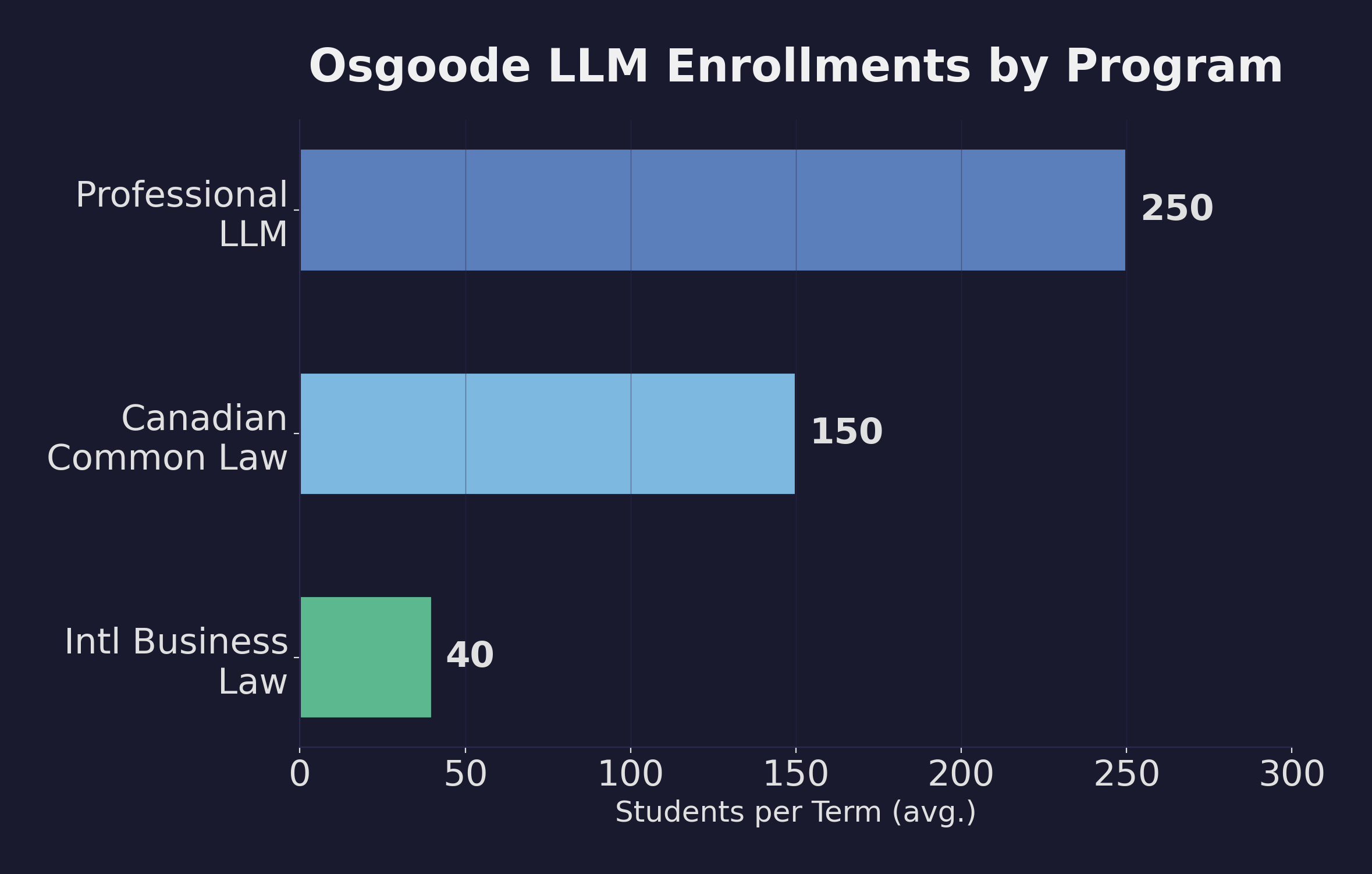
The NCA stream is especially relevant to GTA marketing. Foreign-trained lawyers completing their Canadian Common Law LLM through Osgoode are launching new practices or joining existing shops. A large share of them are building a client book from scratch, which means they need a website that ranks, a Google Business Profile that draws map-pack impressions, and content that reaches the communities they plan to serve. Immigration, real estate, and family practices absorb the bulk of these new entrants.
The University of Toronto Faculty of Law adds its own steady volume on top of that. Taken together, the two schools feed hundreds of new lawyers into the Toronto market every graduating class. The competitive landscape intensifies each articling cycle, and any firm relying on SEO work done five years ago is losing ground every quarter it does not refresh the program.
The Courts
Toronto is the judicial centre of Ontario, and its courthouses carry an equivalent share of the province's litigation volume.
Osgoode Hall, at 130 Queen Street West, is the historic seat of Ontario's judiciary and the headquarters of the Law Society of Ontario. The building houses the Ontario Court of Appeal and the Divisional Court of the Superior Court of Justice, which together generate a steady flow of reported appellate decisions that shape the province's case law.
The Toronto Superior Court of Justice at 361 University Avenue carries the largest civil litigation caseload in Ontario. Personal injury trials, commercial disputes, class actions, and construction files all route through its lists, and it remains the venue that every major provincial litigator expects to appear in multiple times a year.
Old City Hall at 60 Queen Street West moves an enormous volume of Ontario Court of Justice criminal matters through its daily lists. The Scarborough courthouse at 2311 Eglinton Avenue East handles criminal and family work for the eastern GTA.
The Ontario Court of Justice Toronto Region processed over 25,000 criminal matters during 2025. That courtroom volume alone sustains a continuous baseline of demand for defence counsel across the city.
Toronto Court Caseload: Why Online Visibility Matters
The Ontario Court of Justice in Toronto processed approximately 25,200 criminal matters through its lists during 2025:
| Case Category | Approximate Cases (2025) | Share |
|---|---|---|
| Crimes against the person | 8,300 | 33% |
| Administration of justice | 7,800 | 31% |
| Crimes against property | 4,500 | 18% |
| Criminal Code traffic | 1,800 | 7% |
| Other Criminal Code | 1,500 | 6% |
| Federal statute | 1,300 | 5% |
Those numbers cover criminal matters at the Ontario Court of Justice alone. On top of them sit thousands of civil, family, and serious criminal trials at the Superior Court of Justice, plus the province's landlord-and-tenant tribunal, small claims court, immigration proceedings, and the full slate of family court matters distributed across Toronto's courthouses. The aggregate filing count is extraordinary.
Civil Court Delays in Ontario
Court volume this heavy produces persistent backlog. A study published in the University of Toronto Law Journal reviewed 270,266 civil disputes resolved in Ontario during 2019-20 and found that 40,061 of them took longer than two years to reach resolution. That is 14.82% of all civil files. For GTA litigation practices, the backlog produces both a challenge and a business opportunity. Clients looking at multi-year timelines need counsel who communicate clearly throughout the file, manage expectations realistically, and stay visible online for the duration. A firm's website, intake process, and client-facing content all contribute to the retention experience from the first Google search forward.
Every one of those 270,000 files starts with a person who searched for a lawyer online. The firms that own the relevant search results are the ones that receive the intake calls.
How Much Does Law Firm Marketing Cost in Toronto?
Toronto prices at the ceiling of the Canadian legal marketing market, and the rate sheet reflects the volume and depth of competition:
| Service | Typical Cost Range |
|---|---|
| Local SEO retainer (monthly) | $3,000 to $10,000 |
| Competitive practice area SEO (PI, criminal) | $5,000 to $15,000/month |
| Custom law firm website | $10,000 to $20,000 |
| Full-service marketing package (monthly) | $5,000 to $15,000 |
| Google Ads management (monthly) | $2,000 to $6,000 + ad spend |
| Content writing (monthly) | $1,500 to $4,000 |
Toronto agencies routinely charge 30 to 50% more than comparable shops in Hamilton, London, or Kitchener. The premium is not buying sharper work. It is covering downtown office space, client-entertainment budgets, and a sales team.
LawOnline.ca operates from outside the GTA entirely. The overhead is lower, the expertise is deeper, and every dollar a Toronto firm puts into the budget goes toward execution instead of office rent. We provide the strategic and technical depth that downtown Toronto agencies advertise, at rates calibrated to our efficient operating structure.
For a province-wide breakdown of costs, see our law firm marketing pricing guide.
Practice Areas We Market in Toronto and the GTA
- Personal injury -- Motor vehicle collisions on the 401, the Gardiner Expressway, the Don Valley Parkway, and the 404 corridor. Motorcycle and pedestrian injury files. Slip and falls. Medical malpractice. Long-term disability disputes. PI is the highest-value and most contested practice area in the entire country, and the GTA sits at the top of that competitive stack. The highway and transit density of the region produces a constant baseline of motor vehicle cases, and most of those injured parties begin their search for counsel on a phone within hours of the collision.
- Family law -- Divorce, custody, parenting time, child and spousal support, and property division. Search volume across the GTA shows that "divorce lawyer Toronto" consistently outpaces "family lawyer Toronto" despite the latter being the broader category. The metropolitan demand for family law counsel is enormous across Toronto, Mississauga, Markham, Vaughan, Brampton, and the outlying communities.
- Criminal defence -- With more than 25,000 criminal matters a year flowing through the Toronto region alone, demand for defence counsel is continuous. Impaired driving, assault, drug offences, and fraud files dominate the OCJ dockets, while serious indictable matters route to the Superior Court.
- Real estate law -- Residential closings, commercial transactions, and development work. The GTA housing market remains one of the most active in North America, which keeps closings moving on both sides of every transaction. A Wellesley Institute study that geocoded Landlord and Tenant Board data documented the scale of eviction proceedings across Toronto neighbourhoods and traced the intersection of housing law, poverty, and race across the city. Tenant-side and landlord-side practices both operate on that volume.
- Immigration law -- Toronto receives the highest intake of new immigrants of any city in Canada. Work permits, study permits, permanent residency applications, refugee claims, and citizenship files all produce consistent demand, and the NCA pipeline through Osgoode continually adds new specialists to the field.
- Wills and estates -- Estate planning, powers of attorney, estate administration, and contested estates litigation. The GTA's aging population and concentrated wealth base feed this practice area year after year.
- Corporate and commercial -- Business formation files, shareholder agreements, commercial contract drafting, commercial disputes, and M&A work. Toronto is Canada's financial capital, and that concentration produces corporate caseloads no other city in the country generates at the same density.
- Employment law -- Wrongful dismissal files, employment contract negotiation, workplace investigations, and human rights claims. The diversity and scale of the Toronto employment base keep this category in steady demand across every tier of the economy.
Keywords Toronto and GTA Law Firms Should Target
Effective SEO in the GTA is about pairing the right intent with the right geographic resolution. High-value keywords ranked by approximate commercial weight include:
- “personal injury lawyer Toronto”
- “car accident lawyer Toronto”
- “criminal defence lawyer Toronto”
- “divorce lawyer Toronto”
- “personal injury lawyer Mississauga”
Suburb-specific targeting is non-negotiable. Google treats Toronto, Mississauga, Scarborough, Markham, Brampton, Vaughan, North York, and Etobicoke as independent local markets, which means ranking for "personal injury lawyer Mississauga" is a completely separate problem from ranking for "personal injury lawyer Toronto." Firms that build dedicated municipality-level pages and profiles, rather than pointing every search at a single downtown page, climb the rankings faster and pull materially higher-intent local traffic.
Long-tail queries convert at substantially higher rates. A prospect typing "how much does a personal injury lawyer cost in Scarborough" or "free consultation personal injury lawyer Toronto" is closer to booking a consultation than one typing a two-word industry keyword. A mature content plan takes aim at both ends of that spectrum, with practice-area hubs carrying the short heads and FAQ-driven articles picking up the tails.
Get Started with a Free Marketing Audit
We will audit your current website, keyword rankings, Google Business Profile, and direct competitors, then hand back a straight assessment of where your firm stands and what needs fixing first. Nothing generic. A specific read on your online visibility and the opportunities leaking past you.
Instant AI Readiness Check Get Your Free Full Audit
Frequently Asked Questions
Can a law firm actually rank on Google in Toronto?
Yes, with the right strategy and sustained execution. Quick wins in Toronto are rare and almost always short-lived. A realistic timeline for meaningful ranking gains in the most competitive practice areas runs six to twelve months. Less contested categories such as wills and estates or immigration law can begin showing movement sooner. The firms that rank well in this market are the firms that treated SEO as a multi-year investment rather than a quarterly tactic.
How much does law firm marketing cost in Toronto?
Toronto prices at the top of the Canadian market. Most firms invest between $5,000 and $15,000 per month across a combined digital program. Standalone SEO retainers run from $3,000 to $10,000 monthly depending on practice area. The most contested practice areas, including personal injury and criminal defence, can demand $5,000 to $15,000 per month in SEO alone once the content, backlink, and map-pack workstreams are all in motion. Custom builds typically land between $10,000 and $20,000.
Should my firm target suburb-specific keywords?
Yes. Google scores Mississauga, Scarborough, Markham, and the other GTA municipalities as independent local markets. Firms that build dedicated content and Google Business Profiles for each of those areas typically rank faster and pull higher-intent traffic than firms running a single Toronto-centric page. Any practice that serves multiple GTA municipalities needs a keyword strategy tuned to each one.
Why hire a marketing agency outside Toronto?
Because the same depth of expertise is available at a lower price point. Toronto agencies absorb substantial overhead, and that cost is baked into every retainer they send out. Our firm works with Canadian law firms exclusively, knows the GTA search market intimately, and delivers at rates that reflect an operating structure free of downtown rent.
How do I know if my current marketing is actually working?
Put one question to the agency on retainer: how many new signed clients came directly from organic search last month? If the response pivots to impressions, sessions, or other upstream traffic metrics, the campaign is being measured on inputs rather than outcomes. Signed files are the only measure that pays for itself. Everything before them is diagnostic.