
Why do FAQ pages matter so much for law firms? Because they're the content format most likely to appear in Google's AI Overviews, featured snippets, and AI assistant citations. When someone asks ChatGPT "How long do I have to file a personal injury claim in Ontario?" or searches Google for the same question, the answer gets pulled from content that's structured as a direct question-and-answer pair. That's exactly what FAQ pages are.
FAQ pages punch above their weight for three reasons. First, they directly match how people search. Prospective clients ask questions, and FAQ pages answer them. (For a broader look at the content types law firms should be producing, see our guide to the types of blog and website content law firms need.) Second, they're structured in a way that both traditional search algorithms and AI systems can parse, extract, and cite. Third, they target long-tail keywords that blog posts and practice area pages often miss.
For law firms specifically, FAQ content also serves a practical function: it reduces the number of phone calls spent answering basic procedural questions, freeing up intake staff to focus on qualified leads.
The numbers back this up. A national survey by the Canadian Forum on Civil Justice found that 48.4% of adult Canadians face a legal problem in any three-year period, yet only 19% obtain legal advice. One in three search the internet for answers, and 61% get their guidance from friends and family. For the vast majority who never reach a lawyer, a well-structured FAQ page on your website might be the closest thing to real legal information they find.
FAQ vs. Blog Post vs. Practice Area Page: Which Content Goes Where?
Understanding where FAQ content fits in your site architecture prevents duplication and cannibalization.
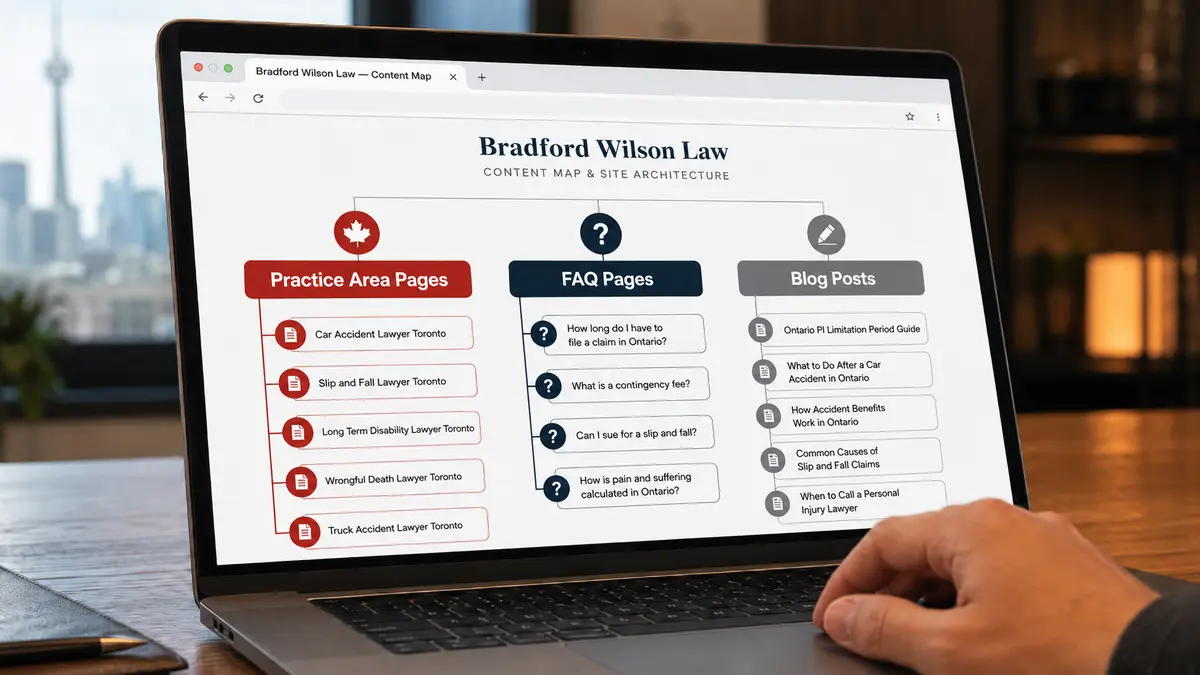
Practice area pages are conversion-focused. They target commercial-intent searches ("car accident lawyer Toronto") and their job is to persuade a visitor to contact your firm. They should include a short FAQ section (4 to 6 questions) at the bottom, but the page's primary purpose is conversion, not information.
Blog posts are informational. They target research-intent searches ("what to do after a car accident in Ontario") and build topical authority over time. A blog post goes deep on a single topic. The depth and length justify dedicated coverage.
FAQ pages sit between the two. They answer specific questions concisely (50 to 150 words per answer) and target the question-format queries that trigger featured snippets and AI Overviews. A dedicated FAQ page can cover 10 to 20 questions about a practice area, each structured for extraction.
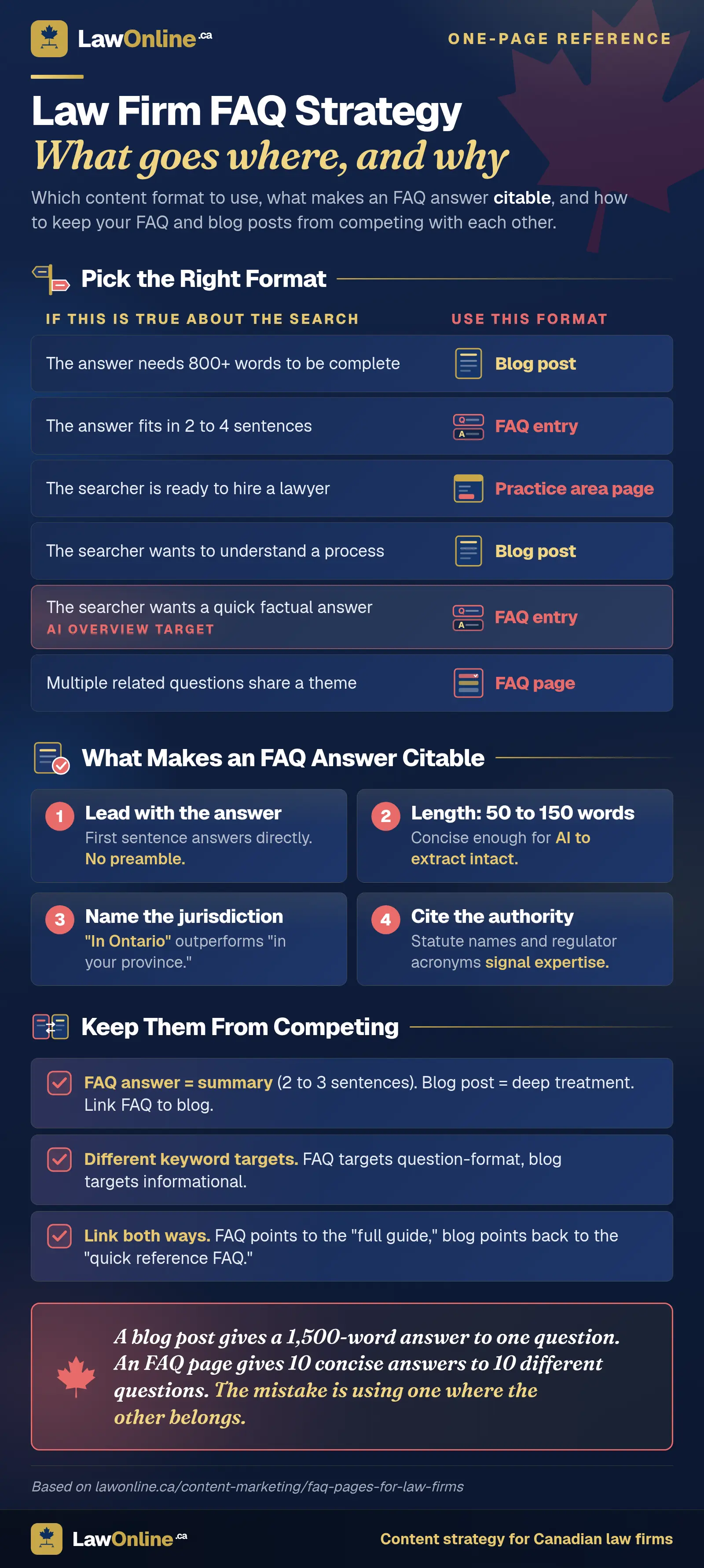
The key distinction: a blog post gives a 1,500-word answer to one question. An FAQ page gives 10 concise answers to 10 different questions. Both formats have a role. The mistake is using one where the other belongs.
When to Use Each Format
| Signal | Best Format |
|---|---|
| The answer requires 800+ words to be complete | Blog post |
| The answer can be given in 2 to 4 sentences | FAQ entry |
| The searcher is ready to hire a lawyer | Practice area page |
| The searcher wants to understand a process | Blog post |
| The searcher wants a quick factual answer | FAQ entry |
| Multiple related questions share a theme | FAQ page |
FAQ Schema: When to Use It and When Not To
Schema markup, also called structured data, is code you add to your website to help search engines understand what your content means, not just what it says. It's invisible to visitors but tells Google whether a page contains question-and-answer pairs, a local business listing, a recipe, or dozens of other content types.
FAQ schema (FAQPage structured data) tells Google that your page contains question-and-answer pairs. When properly implemented, it can trigger rich results in search that display your questions and answers directly on the results page. For law firms chasing featured snippets, it remains one of the strongest structural signals you can send.
What Changed in 2023
Google restricted FAQ rich results in August 2023. Previously, any page with FAQPage schema could earn expandable FAQ dropdowns in search results. Now, only "well-known, authoritative government and health websites" get that treatment consistently.
Does that mean FAQ schema is dead for law firms? No. Here's why it still matters:
AI Overviews and AI assistants. Google's AI Overview system and third-party AI tools like ChatGPT and Perplexity still use structured FAQ data as a strong signal when selecting content to cite. A well-structured FAQ with schema markup is more likely to be quoted in an AI-generated answer than unstructured prose covering the same information.
Featured snippets. FAQ schema doesn't trigger FAQ rich results for most sites anymore, but the question-and-answer structure still increases your chances of earning a paragraph or list featured snippet for the individual questions.
Crawl clarity. Schema markup helps search engines understand the content type and structure of your page, even when it doesn't produce visible rich results.
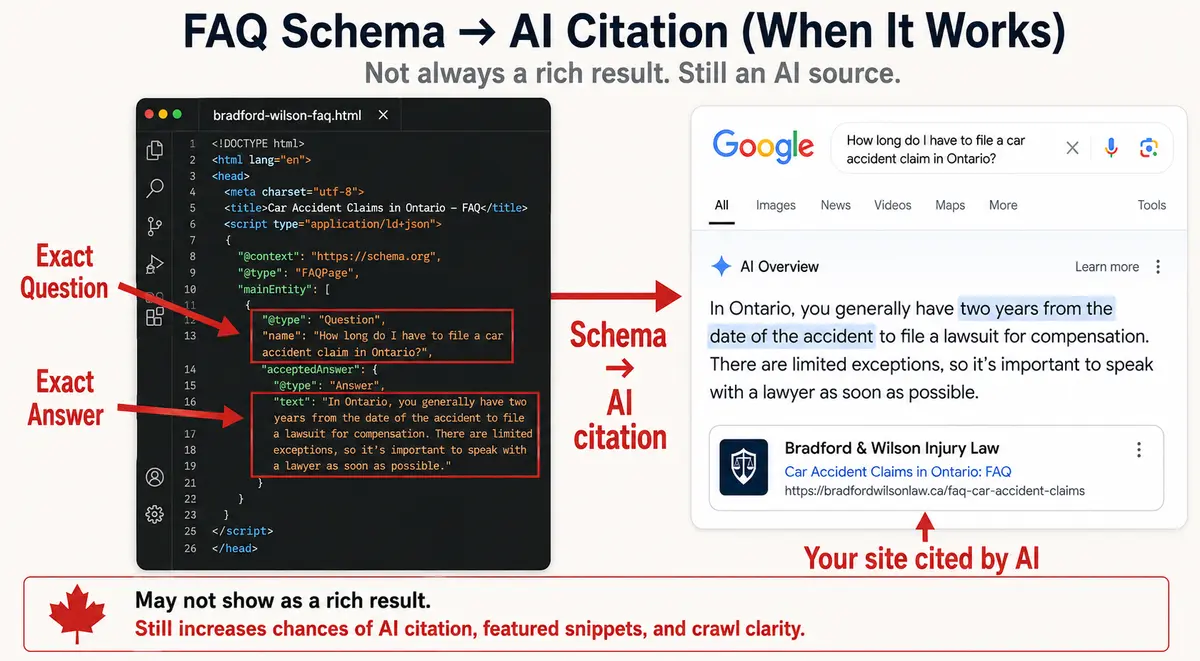
Bottom line: Implement FAQPage schema on all FAQ content. The visible rich-result benefit is diminished, but the AI citation and featured snippet benefits remain. For Canadian law firms building generative engine optimization strategies, FAQ schema is non-negotiable.
Are Featured Snippets Still Worth Chasing Now That AI Overviews Exist?
Yes, but the landscape has shifted. Featured snippets haven't vanished, and they still drive traffic for the types of questions law firm FAQ pages answer. But AI Overviews now dominate far more of the search results page, and understanding how the two differ helps you structure content that performs in both.
How They Work Differently
Featured snippets pull an exact quote from a single source. Google selects one page, extracts your wording word-for-word, and displays it at the top of the results with a direct link back to your site. Your firm gets sole ownership of that answer box.
AI Overviews work differently. Google's generative AI reads multiple sources, synthesizes its own answer, and lists the pages it drew from as citations. Your content might be one of several references, and the wording won't match what you published. It's a citation, not a direct quote.
For law firms, this distinction matters practically. A featured snippet for "How long do I have to file a personal injury claim in Ontario?" displays your exact answer with a link. An AI Overview for the same query blends information from multiple sites and may or may not cite yours.
The Shift in Numbers
Featured snippet visibility has dropped significantly. Ahrefs research shows that featured snippets appeared on roughly 15% of search results pages in early 2025 but fell to about 5.5% by mid-2025. Over the same period, AI Overviews surged from under 4% to over 27% of results pages. The trend is clear: Google is replacing many featured snippets with AI-generated answers.
Why You Should Optimize for Both
Despite the decline, featured snippets still appear consistently for definition queries, procedural questions, and list-based searches. That's exactly the content law firm FAQ pages produce. And unlike AI Overviews, a featured snippet gives your firm the only link in the answer box.
The good news is that the same writing approach wins in both formats. Concise, answer-first FAQ entries with jurisdiction-specific details and named authorities are what both featured snippets and AI Overviews prefer to extract and cite. Structuring your FAQs well doesn't force you to choose between the two. It positions you for whichever one Google shows.
Anatomy of an AI-Overview-Friendly FAQ Answer
Not all FAQ answers are created equal. Here's what makes an answer likely to be extracted and cited by AI systems.
Length: 50 to 150 Words
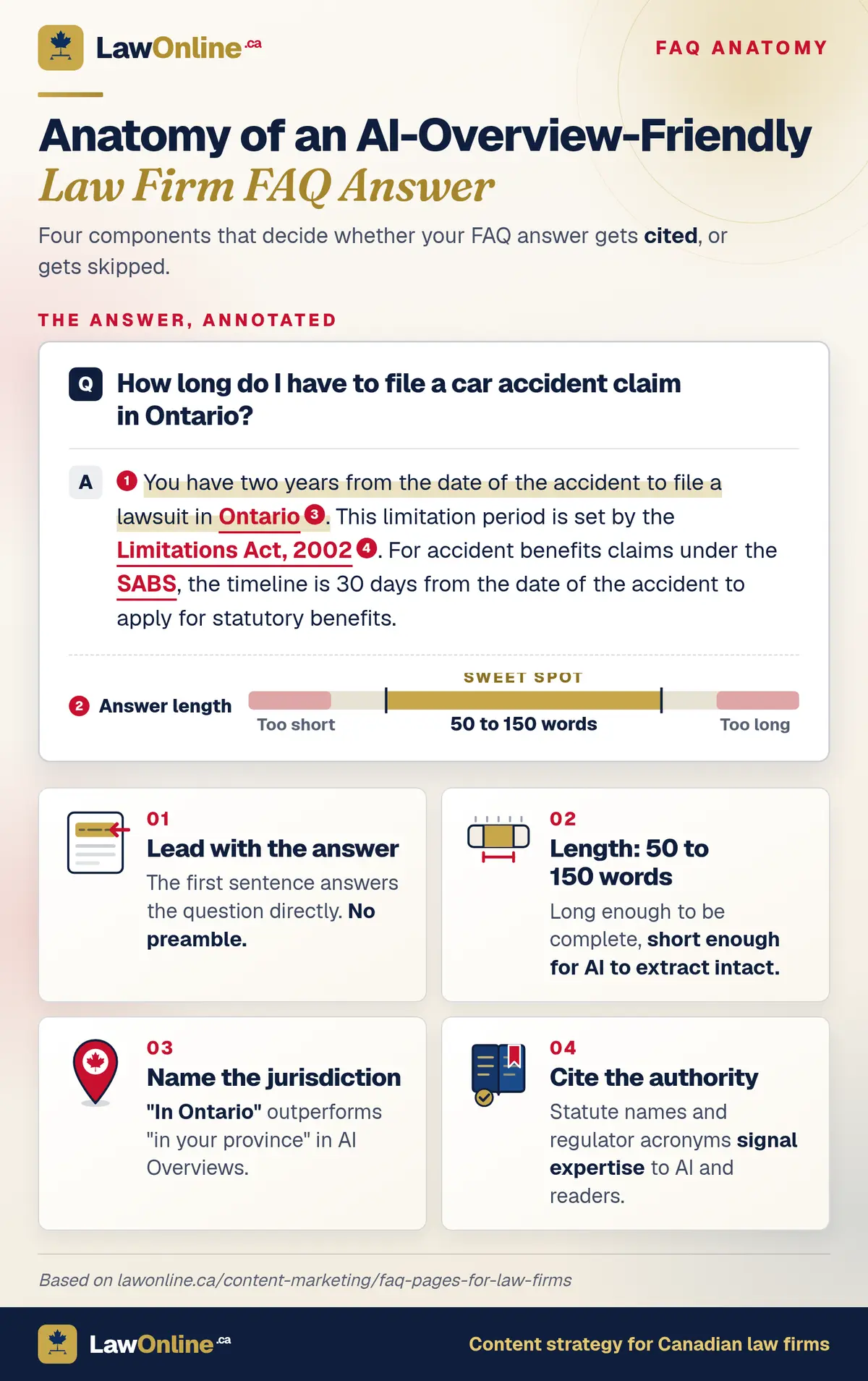
AI Overviews and featured snippets favor concise, complete answers. Too short (under 30 words) and the answer feels insufficient. Too long (over 200 words) and the AI system will extract a partial quote or skip it entirely.
The sweet spot: a direct answer in the first sentence, followed by two to three sentences of supporting context. The answer should be self-contained, meaning someone could read it without any surrounding content and understand the point.
Specificity: Name the Jurisdiction
"The limitation period for personal injury claims varies by province" is too generic. "In Ontario, you have two years from the date of an accident to file a personal injury lawsuit" is specific and citable.
AI systems prefer answers that contain concrete details: dates, dollar amounts, statute names, and jurisdiction-specific facts. Generic answers get passed over in favor of specific ones.
Sourcing: Reference the Authority
When your answer references a statute, regulation, or guideline, name it. "Under the Limitations Act, 2002 (Ontario)" carries more weight with both AI systems and human readers than "under the applicable limitation period." Similarly, citing "FSRA" rather than "the regulator" signals expertise. For YMYL legal content, these specifics are E-E-A-T signals that tell Google the answer comes from a qualified, jurisdiction-aware source rather than a generic content mill.
Structure: Lead with the Answer
Don't use the FAQ format to write mini-essays. The first sentence of every answer should directly answer the question. Supporting context, qualifications, and nuance come after.
Good structure: "Q: How long do I have to file a personal injury claim in Ontario? A: You have two years from the date of the accident to file a lawsuit in Ontario. This limitation period is set by the Limitations Act, 2002. For accident benefits claims under the SABS, the timeline is 30 days from the date of the accident to apply for statutory benefits."
Bad structure: "Q: How long do I have to file a personal injury claim in Ontario? A: This is a common question we receive from clients. The answer depends on several factors, including the type of claim. Generally speaking, there are specific timelines that you need to be aware of..."
The bad example buries the answer. An AI system scanning for extractable content will skip it. (Our content marketing starter guide covers the broader writing principles that apply to all law firm content, including FAQs.)
Worked Example: PI Motor-Vehicle-Accident FAQ Page
Here are eight FAQ questions for a personal injury firm's MVA page, ranked by search intent value.

How long do I have to file a car accident claim in Ontario? Two years from the date of the accident for a lawsuit (Limitations Act, 2002). 30 days to apply for statutory accident benefits (SABS).
Do I need a lawyer for a car accident claim in Ontario? You're not legally required to hire one, but insurance companies employ experienced adjusters and lawyers. Representing yourself in a tort claim or accident benefits dispute puts you at a significant disadvantage.
How much does a personal injury lawyer cost in Ontario? Most PI lawyers in Ontario work on contingency: you pay nothing upfront, and the lawyer's fee is a percentage of your settlement or award (typically 25% to 33%).
What compensation can I get after a car accident in Ontario? Statutory accident benefits (income replacement, medical/rehabilitation, attendant care) and potentially a tort claim for pain and suffering, lost income, and future care costs.
What should I do immediately after a car accident? Seek medical attention, document the scene, exchange insurance information, file a police report, and contact a personal injury lawyer before giving a recorded statement to the at-fault driver's insurer.
What if I was partially at fault for the accident? Ontario follows a comparative negligence system. You can still recover damages, but your award is reduced by your percentage of fault.
How long does a car accident claim take in Ontario? Most motor vehicle accident claims resolve within 18 to 24 months. Complex cases involving serious injuries or disputed liability can take longer.
What's the difference between accident benefits and a tort claim? Accident benefits are no-fault: you receive them regardless of who caused the accident. A tort claim is against the at-fault party for damages that exceed your accident benefits coverage.
Each answer is under 100 words, leads with the direct answer, and references Ontario-specific legislation or procedures.
Worked Example: Family Law FAQ Page

For a Calgary family law firm, a divorce and separation FAQ page might include:
How long does a divorce take in Alberta? An uncontested divorce can be finalized in 3 to 6 months. Contested divorces with custody or property disputes typically take 12 to 24 months.
How is property divided in an Alberta divorce? Under the Matrimonial Property Act, matrimonial property is divided equitably (not necessarily equally). Each spouse's contribution, the length of the marriage, and other factors are considered.
How is child support calculated in Canada? Child support is determined by the Federal Child Support Guidelines based on the paying parent's income and the number of children. Provincial tables specify the base amounts.
Can I get spousal support in Alberta? Spousal support is not automatic. The court considers the length of the marriage, each spouse's financial situation, and whether one spouse sacrificed career opportunities during the marriage.
How to Keep FAQs from Cannibalizing Your Blog Posts
Content cannibalization is a common concern: if you answer "How long do I have to file a personal injury claim in Ontario?" in an FAQ and also have a 1,500-word blog post on the same topic, won't they compete with each other?
They can. Here's how to prevent it:
Make the FAQ answer a summary, not a replacement. The FAQ entry gives the direct answer in two to three sentences. The blog post goes deep: explaining exceptions, recent case law, practical implications. The FAQ answer should link to the blog post for the full treatment.
Use different keyword targets. The FAQ targets the question-format keyword ("how long to file personal injury claim Ontario"). The blog post targets the informational keyword ("Ontario personal injury limitation period guide"). Different intents, different formats, different SERP features.
Link between them. The FAQ entry links to the blog post with "For a detailed explanation, see our full guide to Ontario PI limitation periods." The blog post links back to the FAQ page as a quick-reference resource. This internal linking structure tells Google that the two pages serve different functions.
Use canonical signals correctly, but sparingly. If you genuinely worry about competition, designate the blog post as the primary resource and keep the FAQ answer shorter and more referential. Be aware that adding a canonical tag pointing the FAQ page to the blog post means the FAQ page won't earn its own search visibility: use this only as a last resort, not a default.
Frequently Asked Questions (about Frequently Asked Questions)
Should every practice area page on a law firm website include an FAQ section?
Not necessarily, but it's a strong default. A practice area page with 4 to 6 relevant FAQ questions at the bottom targets long-tail searches that the page's main body doesn't address. It also provides structured content for AI citation. The questions should be specific to that practice area and that jurisdiction, not generic placeholders.
How many questions should a dedicated law firm FAQ page have?
A dedicated FAQ page covering a single practice area works best with 8 to 15 questions. Fewer than 8 and the page feels thin. More than 20 and it becomes unwieldy for readers and dilutes the topical focus. Group questions by subtopic if you have more than 12.
Is FAQ schema still worth implementing for law firm websites?
Yes. The visible rich-result benefit has diminished since Google's August 2023 update, but FAQPage schema remains valuable for AI citation signals, crawl clarity, and internal data structure. For firms pursuing content marketing and AI visibility strategies, FAQ schema is a low-effort, high-upside investment.
How often should FAQ pages be updated?
Review FAQ content at least twice a year, or whenever relevant legislation changes. Outdated answers (referencing old limitation periods, defunct programs, or superseded regulations) undermine trust and can hurt rankings. Mark each FAQ page with a "Last updated" date so both visitors and search engines know the content is maintained.
Can AI tools help generate FAQ content for law firm websites?
AI tools can suggest questions and draft initial answers, but every FAQ answer on a law firm's website must be reviewed for legal accuracy by a qualified professional. An incorrect answer about limitation periods or accident benefits doesn't just perform poorly in search. It creates potential liability for the firm. Use AI for research and drafts, not as the final word.