
Law firm marketing is how Canadian practices attract qualified clients through search engines, advertising, content, social media, and email. This page covers what law firm marketing involves, how it differs from general marketing, what it costs, which channels deliver results, how strategy changes by practice area and firm size, and what to look for in a marketing agency that actually understands legal.
Table of Contents
- What Does Law Firm Marketing Include?
- How Much Does Law Firm Marketing Cost?
- Why Is Law Firm Marketing Different from General Marketing?
- How Does Law Firm Marketing Differ by Practice Area?
- How Does Firm Size Affect Marketing Strategy?
- How Is Law Firm Marketing Different in Canada?
- Law Society Advertising Rules Across Provinces
- Which Marketing Channels Work Best for Law Firms?
- How Do You Evaluate a Law Firm Marketing Agency?
- What Does LawOnline Cover?
- Law Firm Marketing by the Numbers
- Ready to Talk About Marketing?
- Frequently Asked Questions
What Does Law Firm Marketing Include?
Legal marketing is everything a law firm does to attract, convert, and retain clients through digital and traditional channels. It includes search engine optimization, paid advertising, content marketing, social media, email campaigns, reputation management, and branding. Each channel serves a different purpose in the intake pipeline, and the right mix depends on the firm's practice areas, geography, and growth targets.

The difference between legal marketing and generic business marketing is scope and stakes. A restaurant that ranks second on Google loses a dinner reservation. A personal injury firm that ranks second loses a catastrophic injury file worth six or seven figures. The consequences of getting marketing wrong are proportionally higher for law firms, which is why strategy has to be built around retainer economics and case value, not impressions and click-through rates.
Forty-two percent of Canadians discover legal services through search engines (Department of Justice Canada, Pathways to Justice, 2023). That number keeps climbing. A legal marketing strategy that doesn't prioritize how the firm appears in those searches is leaving the highest-intent clients to competitors.
The Core Channels
Marketing for lawyers spans six primary channels. Most firms need a combination, weighted toward the channels that match their practice area economics and competitive landscape.
- SEO and content. Organic search is the foundation. Blog posts, practice area pages, and legal guides target the queries potential clients type into Google. For most firms, SEO delivers the highest long-term ROI of any marketing channel.
- Paid advertising. Google Ads and paid social. Delivers leads immediately but at a cost that increases over time, especially in competitive practice areas like personal injury.
- Content marketing. Blog posts, legal guides, case type pages, and guest publications. Builds topical authority and generates organic traffic that compounds over time. Our content marketing page covers this in depth.
- Social media. LinkedIn for professional visibility and referral network maintenance. Facebook and Instagram for community engagement and brand awareness. Less direct than search, but valuable for keeping the firm visible between referrals.
- Email. Newsletters, case updates, and nurture sequences for prospects who aren't ready to hire yet. Low cost, high intent when done well, because the audience has already opted in.
- Reputation management. Review generation, review response, and monitoring across Google Business Profile and other platforms. Reputation is the bridge between ranking in search and earning the click.
How Much Does Law Firm Marketing Cost?
Most Canadian law firms spend between $3,000 and $15,000 per month on marketing, depending on scope, practice areas, and competitive market. The table below breaks down typical cost ranges by service.
| Service | Monthly Range (CAD) | What It Covers |
|---|---|---|
| SEO | $1,500 - $5,000 | Technical SEO, on-page optimization, local search, link building |
| Content marketing | $1,000 - $4,000 | Blog posts, practice area pages, legal guides |
| Google Ads (PPC) | $2,000 - $10,000+ | Ad spend + management; PI and criminal keywords are the most expensive |
| Social media | $500 - $2,000 | LinkedIn, Facebook, Instagram management and content |
| Email marketing | $300 - $1,000 | Newsletters, nurture sequences, referral campaigns |
| Full-service retainer | $3,000 - $15,000 | Combined program across multiple channels |
The economics depend on practice area. A personal injury firm with $100,000+ average case values can justify a $10,000/month marketing budget because a single signed case covers the spend many times over. A sole practitioner in family law operating on $3,000-$5,000 retainers needs a leaner approach weighted toward SEO and content that compounds over time.
Two rules of thumb: firms in competitive markets (Toronto, Vancouver, Calgary) spend more because the cost to rank and advertise is higher. And firms with higher average case values can afford a larger marketing investment with a faster breakeven.
For a detailed breakdown, see our full guide to law firm marketing costs in Canada.
Why Is Law Firm Marketing Different from General Marketing?
Legal marketing operates under constraints that don't exist in other industries. Three in particular shape every strategic decision a marketing agency or in-house team needs to make.
Regulatory compliance. Every Canadian province has Law Society rules governing how lawyers advertise. Ontario's Rules of Professional Conduct require that all marketing be true, accurate, and verifiable. Alberta is stricter about specialization claims. British Columbia has its own framework. A marketing agency that doesn't understand these rules will produce content that creates compliance risk for the firm.
YMYL scrutiny. Google classifies legal content as "Your Money or Your Life," its highest quality standard. Content about legal rights, procedures, and outcomes faces stricter ranking criteria than content about most other industries. Thin, generic, or inaccurate content doesn't just underperform. It actively hurts the firm's search visibility.
Retainer economics. A single signed personal injury case can be worth more than an entire year of marketing spend. A single family law retainer justifies months of content production. Marketing for lawyers has to be built around the value of the cases the firm wants, not around generic metrics like cost per lead. A thousand leads that don't convert to signed cases is a thousand wasted conversations.
How Does Law Firm Marketing Differ by Practice Area?
The marketing mix that works for a personal injury firm won't work for a corporate boutique. Each practice area has different client acquisition economics, competitive dynamics, and channel priorities. Here's how lawyer marketing strategy shifts across the four most common practice areas.
Personal Injury
PI firms face the most competitive marketing landscape in Canadian legal. Case values are the highest, which attracts the most competitors, which drives up advertising costs. Google Ads for personal injury keywords routinely exceed $50 per click in major Canadian markets.

The sustainable approach for most PI firms: invest heavily in SEO and content marketing to build organic traffic that compounds over time, use paid search as a bridge while rankings build, and maintain a strong Google Business Profile for local visibility. A comprehensive guide on accident benefits in Ontario, published once, can rank for years and generate a steady stream of qualified inquiries at zero incremental cost.
For a detailed breakdown, see our personal injury law firm marketing guide.
Criminal Defence
Criminal defence marketing is time-sensitive. Potential clients search when they've been charged or expect to be. They need a lawyer now, not next week. That makes paid search more important for criminal firms than for most other practice areas, because the decision window is short and intent is high.
SEO still matters, but the content strategy is different. Criminal defence content needs to address specific charges (impaired driving, assault, fraud) and explain the process in plain language. The firms that rank for "criminal lawyer [city]" and have strong reviews convert at high rates because the search intent is urgent and specific.
Family Law
Family law clients are often in emotional, high-stress situations. They research more before hiring. They read reviews, compare multiple firms, and look for a lawyer who feels like the right fit. That makes content marketing and reputation management more important for family law than for practice areas with faster decision cycles.
Email marketing also plays a stronger role. Prospective family law clients often aren't ready to hire immediately. A nurture sequence that provides useful information over weeks or months keeps the firm top of mind when they're ready to move forward.
Corporate and Commercial
Corporate clients don't typically find their lawyers through Google Ads. Referrals, professional networks, and reputation drive most business law engagements. That makes LinkedIn the primary marketing channel for corporate firms, supplemented by thought leadership content (legal guides, market analyses, regulatory updates) that demonstrates expertise.
SEO still matters for corporate firms, but the keyword targets are different. Instead of "lawyer near me," corporate firms target specific practice areas and industry terms that decision-makers search when evaluating outside counsel.
How Does Firm Size Affect Marketing Strategy?
Solo Practitioners and Small Firms (1-5 Lawyers)
Budget is the primary constraint. Most solo and small firms spend $1,500 to $4,000 per month on marketing. The priority is efficiency: focus on one or two channels that deliver the best ROI for the firm's practice area, rather than spreading thin across everything.
For most small firms, that means SEO and content marketing as the foundation, supplemented by Google Business Profile optimization and review generation. Paid search can work, but the budget needs to be tightly managed. A small PI firm in Hamilton can't compete on ad spend with a national firm, but it can outrank that firm organically with better local content and stronger topical authority.
Mid-Size Firms (6-25 Lawyers)
Mid-size firms have more budget flexibility ($5,000 to $10,000/month is typical) and usually need marketing across multiple practice areas. The challenge is coordination. Each practice group has different competitive dynamics and different ideal clients, so the marketing strategy needs to be segmented rather than one-size-fits-all.
Mid-size firms also benefit from brand building. They're large enough that name recognition matters in their market but small enough that they can't rely on reputation alone. A consistent content program, active LinkedIn presence, and regular community visibility create the kind of awareness that makes referrals and organic inquiries more likely.
Large Firms (25+ Lawyers)
Large firms typically spend $10,000 to $25,000+ per month on marketing and have the resources for a multi-channel approach. The focus shifts from lead generation to brand positioning, thought leadership, and market differentiation.
SEO for large firms is more complex because they compete across many practice areas and often multiple cities. The content volume required is higher, and the strategy needs to account for internal competition between practice groups targeting similar keywords. Paid search is usually reserved for high-value case types where the conversion economics justify the spend.
How Is Law Firm Marketing Different in Canada?
Canadian legal marketing operates in a fundamentally different environment than the US, and most online lawyer marketing advice comes from American sources. Three differences matter most.
Provincial regulation varies. There's no single set of advertising rules. Ontario, Alberta, British Columbia, and every other province have their own Law Society regulations. A marketing strategy that works in one province may violate the rules of another. Any marketing for lawyers that crosses provincial lines needs to account for these differences. See our Canadian vs US legal marketing comparison for the full breakdown.
Smaller markets mean different math. A personal injury firm in Toronto competes in a market roughly one-tenth the size of New York or Los Angeles. That means lower search volumes, fewer competitors, and lower advertising costs, but it also means the margin for error is smaller. Ranking on page two in Toronto is a bigger problem than ranking on page two in a US metro because the total search volume is lower and each lost position represents a larger share of available demand.
Bilingual and regional considerations. Firms in Quebec, New Brunswick, and parts of Ontario need to consider French-language marketing. Even outside officially bilingual markets, Canada's multicultural demographics mean that some firms benefit from content in Mandarin, Punjabi, or other languages depending on their local market and practice areas.
The bottom line: importing a US marketing playbook without adapting it to Canadian market realities wastes money. The tactics are similar. The scale, regulation, and competitive dynamics are not.
Law Society Advertising Rules Across Provinces
Every province regulates how lawyers can market their services. The rules vary, and a marketing strategy that works in one province may violate the rules of another. Any legal marketing agency working with Canadian firms needs to understand these differences.
Ontario. The Law Society of Ontario requires that all marketing be true, accurate, and verifiable. Testimonials are permitted but must not be misleading. Fee advertising must be clear and complete. Unverifiable claims about results or outcomes are prohibited.
Alberta. The Law Society of Alberta applies stricter rules around specialization. Lawyers cannot claim to be specialists unless they hold a certified specialist designation. Marketing must be factual and not misleading. The rules around testimonials and endorsements are more restrictive than Ontario's.
British Columbia. The Law Society of BC permits marketing but requires it to be dignified, accurate, and not misleading. Rules around endorsements and comparative claims are conservative.
These aren't suggestions. Violations can result in complaints, investigations, and disciplinary proceedings. A marketing agency that produces content making unverifiable outcome claims, uses misleading testimonials, or misrepresents a lawyer's credentials creates real professional risk for the firm. This is one of the clearest reasons why law firms need a marketing partner that understands the regulatory landscape, not a generalist agency learning on the job.
For province-specific breakdowns, see our guides to Ontario advertising rules, Alberta advertising rules, and BC advertising rules.
Which Marketing Channels Work Best for Law Firms?
Every channel has a different timeline, cost structure, and lead quality profile. The right mix depends on the firm's budget, practice area, and growth targets.
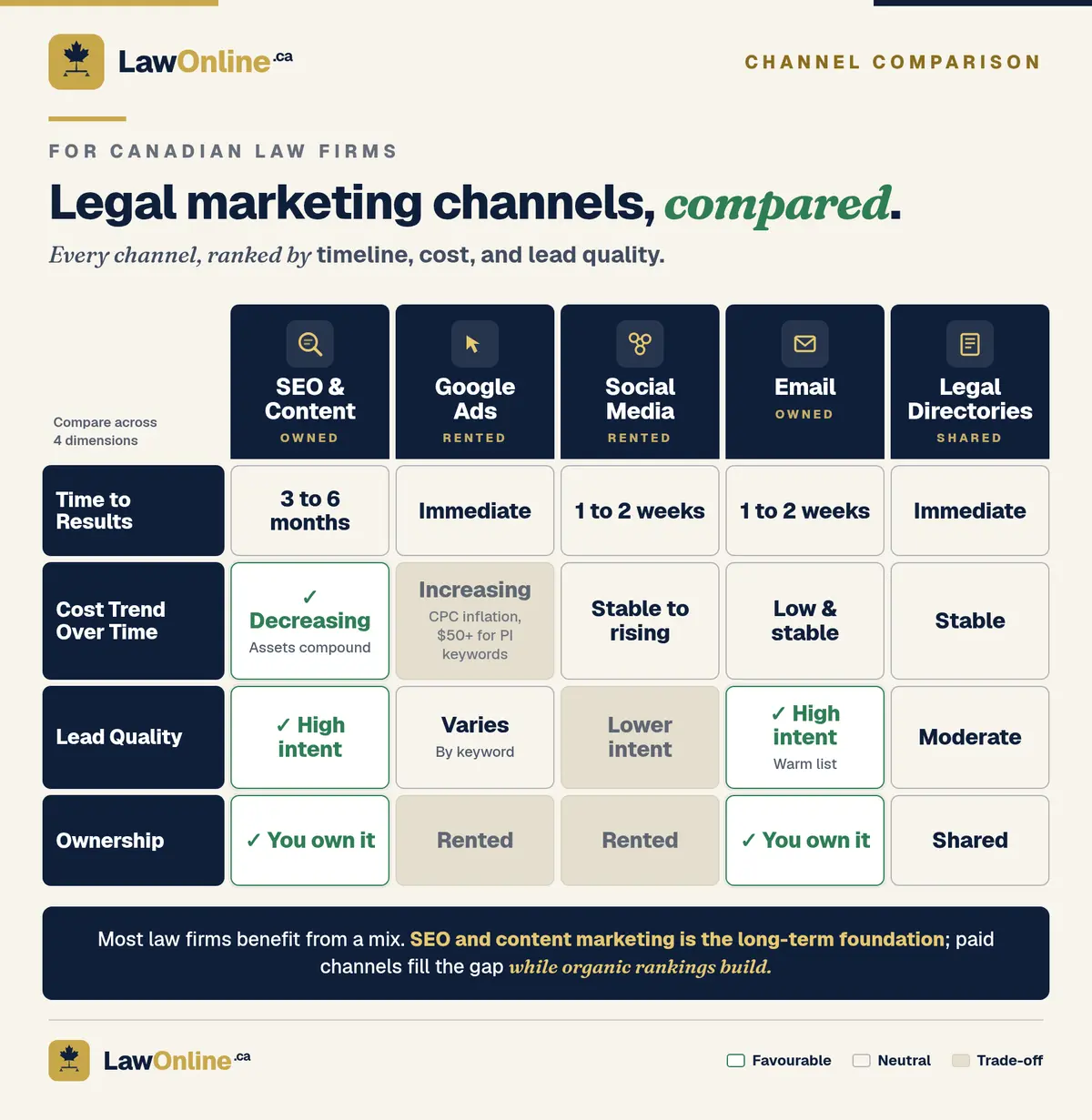
| Channel | Time to Results | Cost Trend | Lead Quality | Ownership |
|---|---|---|---|---|
| SEO & Content | 3-6 months | Decreasing (assets compound) | High intent | You own it |
| Google Ads | Immediate | Increasing (CPC inflation) | Varies by keyword | Rented |
| Social Media | 1-2 weeks | Stable to increasing | Lower intent | Rented |
| 1-2 weeks | Low and stable | High intent (warm list) | You own it | |
| Legal Directories | Immediate | Stable | Moderate | Shared |
SEO and content marketing is the long-term foundation for most legal marketing programs. It takes three to six months to see meaningful results, but the returns compound. A blog post that ranks today generates inquiries for years. For PI firms facing $50+ CPCs on Google Ads, SEO is one of the few realistic ways to build sustainable lead flow.
Google Ads delivers results immediately. Personal injury, family law, and criminal defence keywords carry the highest costs per click. Paid search works best as a bridge while organic rankings build, or as a complement for high-value case types where the conversion economics justify the spend.
Social media is a visibility and referral channel, not a direct lead generator for most firms. LinkedIn is the strongest platform for professional services. Facebook and Instagram work for community-focused practices. The ROI is harder to measure than search, but for firms that rely on referral networks, staying visible matters.
Email marketing is underused by Canadian law firms. A monthly newsletter to past clients, referral sources, and prospects who opted in costs almost nothing to produce and keeps the firm top of mind. For firms with a large existing contact base, email is one of the highest-ROI channels available. See our email marketing guide for the full approach.
Legal directories provide baseline visibility but limited differentiation. Every firm that pays for a listing appears alongside competitors. Directories are table stakes, not a growth strategy.
For most law firms, the best approach is a weighted mix: SEO and content marketing as the foundation, paid advertising for immediate lead generation, email for nurturing, and social media for visibility. The weighting shifts based on practice area. A high-volume PI firm needs aggressive content and paid search. A boutique estate planning practice may get more value from referral-focused email and LinkedIn.
How Do You Evaluate a Law Firm Marketing Agency?
Not all agencies that claim to serve law firms actually understand the legal industry. Here's what to look for when evaluating a legal marketing agency.
Ask what they measure. An agency focused on traffic and impressions is optimizing for the wrong outcomes. The metric that matters is cost per signed case. If the agency can't explain how their work connects to your intake pipeline and retainer revenue, they're selling activity, not results.
Ask about compliance. If the agency hasn't mentioned Law Society advertising rules by the end of the first conversation, that's a signal. Compliance isn't an afterthought. It's a baseline requirement for any content, ad copy, or social media post the agency produces.
Ask who writes the content. Content quality is a direct ranking factor under Google's E-E-A-T framework. Generic content written by someone who doesn't understand Canadian law, provincial court systems, or legal terminology won't rank well and won't build trust with the readers who matter.
Ask about specialization. An agency that also serves plumbers, chiropractors, and e-commerce brands is spreading expertise thin. Lawyer marketing has regulatory requirements, competitive dynamics, and conversion patterns that don't apply to other industries. Specialization matters.
Check their own rankings. If a legal marketing agency can't rank their own website for competitive terms, that tells you something about whether they can rank yours.
What Does LawOnline Cover?
We handle the full scope of marketing for Canadian law firms. Each service is built to integrate with the others, so the firm's marketing works as a system rather than a collection of disconnected tactics.
- Search engine optimization. Technical SEO, local search, content strategy, and AI visibility (GEO). Measured by qualified inquiries, not keyword positions.
- Law firm web design and development. Custom law firm websites built for speed, conversion, and intake integration. You own everything.
- Content marketing. Blog posts, practice area pages, legal guides, and guest publications. Human-written by a Canadian team that understands legal concepts and Law Society rules.
- Brand identity. Logo, colours, typography, voice, and positioning that differentiates the firm in a competitive market.
- Paid advertising. Google Ads and paid social campaigns built around case value and conversion economics.
- Email marketing. Newsletters, nurture sequences, and referral communications.
- Reputation management. Review generation, monitoring, and response strategy.
Every engagement starts with the firm's practice areas, target case types, and retainer economics. We build the law firm marketing plan around the cases the firm actually wants, then measure results by cost per signed case and ROI by practice area.
Law Firm Marketing by the Numbers
The data below shapes how we build legal marketing strategies for Canadian law firms. These aren't abstract benchmarks. They're the numbers that determine which channels are worth the investment and which are draining budget without delivering signed cases.
| Metric | Value | Source |
|---|---|---|
| Canadians who find legal services via search | 42% | Department of Justice Canada, Pathways to Justice, 2023 |
| Average Google Ads CPC for PI keywords (Canada) | $50+ | Industry benchmark, 2026 |
| Higher inquiry rate from content-driven marketing | +23% | Clio Legal Trends Report Canada, 2024 |
| Three-year SEO ROI | 526% | Andava Legal Marketing, 2026 |
| SEO breakeven point | 14 months | Andava Legal Marketing, 2026 |
| Law firms using digital marketing | 72% | Canadian Bar Association, Legal Technology Survey, 2024 |
| Clients who check online reviews before hiring | 84% | Clio Legal Trends Report Canada, 2024 |
| Average conversion rate for law firm websites | 3.3% | Industry benchmark, 2025 |
| Increase in AI-driven legal searches (year over year) | 3x | LawOnline AI Readiness Audit, 2026 |
| Local search resulting in same-day contact | 76% | Google Search Central, Near Me Study, 2024 |

Ready to Talk About Marketing?
If your firm's marketing isn't generating the consultations and signed cases it should, the strategy is the problem. We'll review your current marketing, identify the gaps, and show you what a law firm marketing plan looks like for your practice areas and competitive landscape. Framed around cost per signed case, not vanity metrics.
This is a strategic conversation, not a sales pitch. No obligation, no pressure.
Frequently Asked Questions
What is law firm marketing?
Law firm marketing is the full set of strategies and channels a legal practice uses to attract new clients, build its reputation, and grow revenue. It covers search engine optimization (SEO), paid advertising (Google Ads), content marketing (blog posts, legal guides, practice area pages), social media, email marketing, reputation management, and branding. Unlike marketing for other industries, law firm marketing must comply with provincial Law Society advertising rules and meet Google's YMYL content standards. The goal isn't traffic or impressions. It's cost per signed case and ROI by practice area.
How much does law firm marketing cost?
It depends on the scope. A firm that needs SEO, content, and paid advertising invests more than one that needs content alone. Monthly retainers for comprehensive law firm marketing in Canada typically range from $3,000 to $15,000, depending on the firm's size, practice areas, and competitive market. During our initial consultation, we scope the firm's needs and provide transparent pricing before any work begins. For a broader view of costs, see our guide to law firm marketing costs in Canada.
How long does it take for law firm marketing to produce results?
Paid advertising delivers leads immediately, but the cost is ongoing. SEO and content marketing take three to six months to produce meaningful organic traffic, with the most significant growth between six and twelve months. The returns compound over time. A blog post published today generates inquiries for years without additional spend. Most firms benefit from running paid channels while organic results build.
What's the difference between law firm marketing and law firm SEO?
SEO is one component of law firm marketing. Marketing for lawyers covers the full scope: SEO, paid advertising, content, social media, email, branding, and reputation management. SEO specifically focuses on organic search visibility. For most firms, SEO is the highest-ROI channel and the foundation of the marketing strategy, but it works best as part of a coordinated plan. See our SEO & GEO page for the full breakdown.
Do I need a specialized law firm marketing agency?
You don't have to use one, but the results are different. A generalist agency will need to learn Law Society advertising rules, legal terminology, YMYL content requirements, and the competitive dynamics of the legal market. A specialized agency already understands these constraints and builds strategy around them. The most common complaint we hear from firms switching agencies is that the previous agency produced generic content that didn't demonstrate any understanding of law.
Is content marketing or Google Ads better for a law firm?
They serve different purposes and work best together. Google Ads delivers immediate leads at a per-click cost that increases over time. Content marketing takes months to build but generates leads at a decreasing cost as organic rankings compound. For personal injury firms facing $50+ CPCs, content marketing is often the only sustainable long-term strategy. For firms that need leads now, paid search fills the gap while content builds.
What marketing channels should a personal injury firm prioritize?
SEO and content marketing first, paid search second, reputation management third. PI firms face the highest advertising costs in the Canadian legal market, which makes organic traffic the most valuable long-term asset. A strong content program built around accident types, benefits, limitation periods, and the claims process generates qualified inquiries at a fraction of the cost of Google Ads. Paid search fills the gap while organic rankings build, and a strong review profile on Google Business Profile influences which firm gets the click.
How do I create a law firm marketing plan?
Start with three questions: which practice areas and case types does the firm want to grow, what's the average case value for each, and what's the competitive landscape in your market? Those answers determine budget allocation and channel priority. A typical law firm marketing plan includes SEO and content marketing as the long-term foundation, paid search for immediate lead generation (especially for high-value practice areas), Google Business Profile optimization for local visibility, a review generation strategy, and email nurture for prospects who aren't ready to hire yet. Set clear KPIs: cost per signed case by practice area, not vanity metrics like traffic or impressions. Review and adjust quarterly based on what's actually generating consultations.