Most Canadian law firms have no idea how many legal directory listings reference their practice. They also have no idea that several of those listings contain an old phone number, a previous office address, or a misspelled firm name. That quiet inconsistency is one of the largest unaddressed local SEO problems in the Canadian legal market, and it's dragging down local search rankings every single day.
Citation building isn't glamorous. It doesn't make a slide in a marketing pitch look exciting. But for law firms that rely on local search to generate consultations, it's one of the highest-leverage activities in SEO. Done well, it improves your Google Maps rankings, strengthens your domain authority, and builds the kind of local relevance signals Google can't ignore.
Done poorly, or not at all, it leaves rankings on the table and erodes the trust search engines have in your listing data.
This guide explains what citations actually are, which Canadian legal directories are worth your time, how to audit your existing citations, and how to build new ones without wasting hours on low-value listings.
What Is a Citation and Why Does It Matter?
A citation is any online mention of your law firm's name, address, and phone number (NAP). Google uses these mentions as trust signals. When your NAP data appears consistently across high-authority websites, Google gains confidence that your firm is a legitimate local business operating at a specific location.
That confidence translates into better local rankings. Especially in the Local Pack, which is the three-firm block at the top of Google Maps search results. For practice areas where local intent dominates, such as personal injury, family law, and criminal defence, Local Pack visibility is frequently worth more than the top organic position.
There are two types of citations worth understanding:
Structured citations live on directory sites, legal platforms, and review sites. They follow a predictable format with explicit fields for business name, address, phone number, website, hours, and services. Think Google Business Profile, Yellow Pages, and Canadian Lawyer directories.
Unstructured citations appear in the flowing text of news articles, blog posts, press releases, and association pages. They're still valuable, often more so because they signal organic relevance, but harder to control.
Most citation-building work focuses on structured citations because you can audit, edit, and fix them systematically. That's what this guide covers.
The NAP Consistency Problem
Before building any new citations, fix the ones you already have. NAP consistency across every listing is the single most controllable factor in local SEO, and inconsistent data hurts more than missing citations.
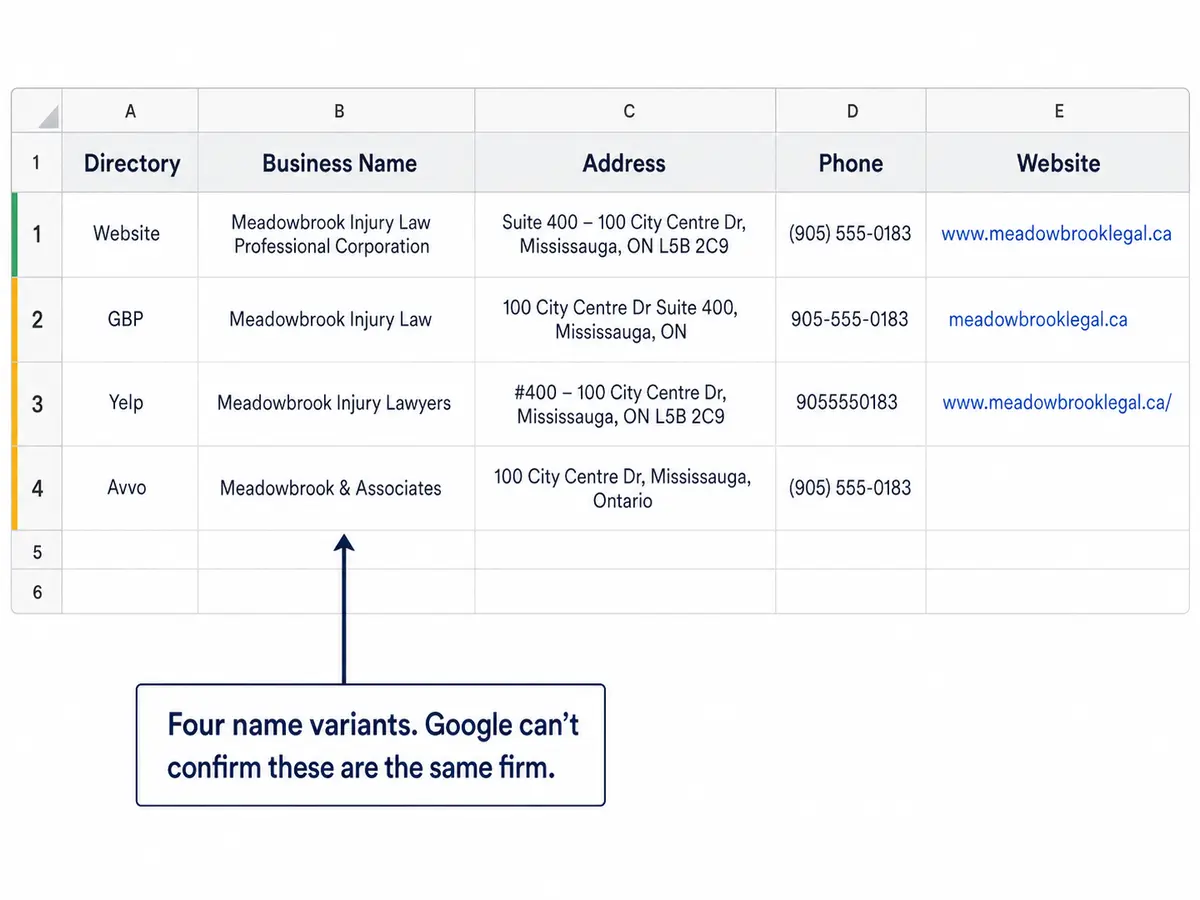
Here's what inconsistency looks like in the wild. A personal injury firm in Mississauga operates as "Meadowbrook Injury Law Professional Corporation" on their website. On Google Business Profile they appear as "Meadowbrook Injury Law." On Yelp they are "Meadowbrook Injury Lawyers." Their old Canada411 listing still shows "Meadowbrook & Associates" from before the name change three years ago.
From Google's perspective, those four variations could plausibly be four different firms. The algorithm can't be certain they all represent the same entity. That uncertainty gets baked into the relevance score that determines rankings.
The same problem happens with addresses. "Suite 400" versus "#400" versus "Unit 400" versus no suite number at all. "Toronto, ON" versus "Toronto, Ontario" versus "North York, ON." These look trivial to humans. They're not trivial to local search algorithms.
Your first task is picking one canonical version of your NAP data and writing it down. That version becomes the source of truth every citation must match. Pick the exact spelling, punctuation, suite format, phone number format, and provincial abbreviation you want to use everywhere, and then stick with it.
Which legal directories actually matter for Canadian law firms?
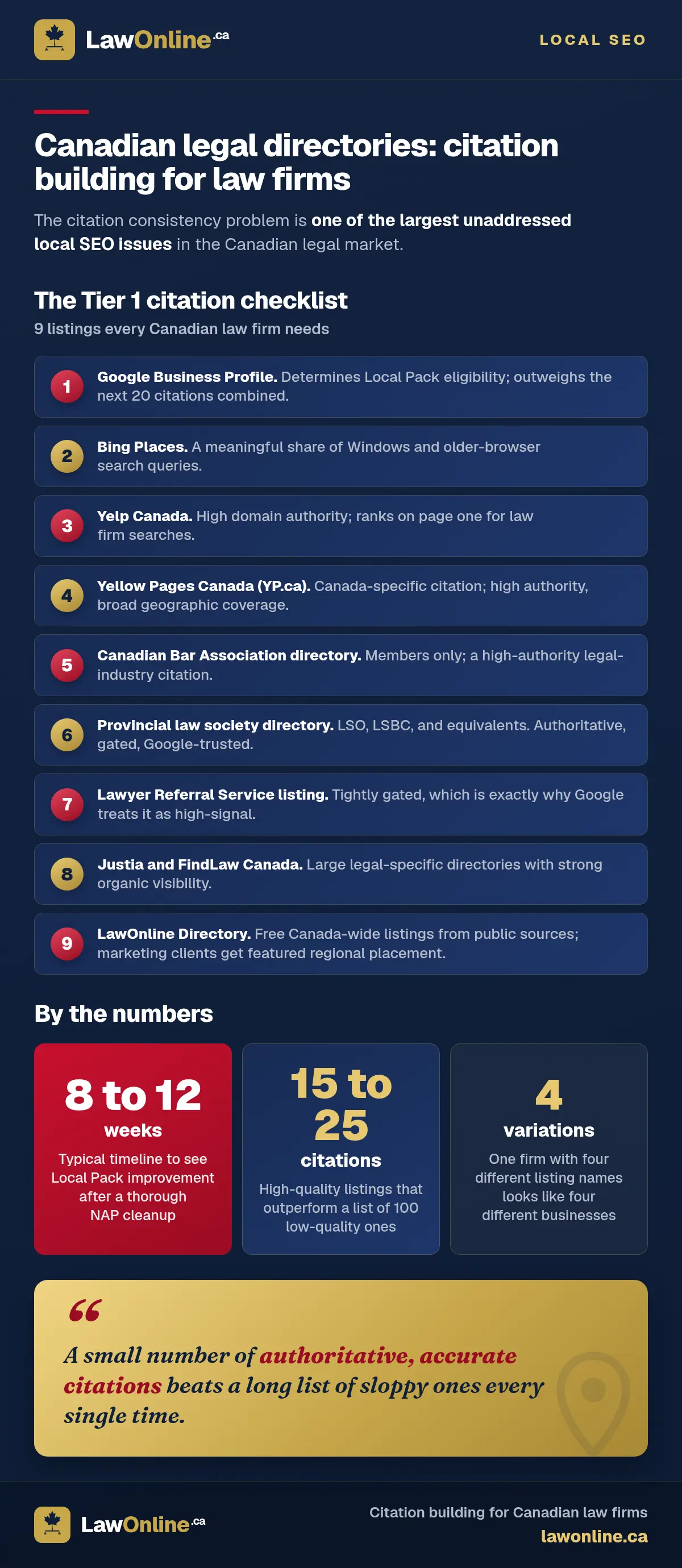
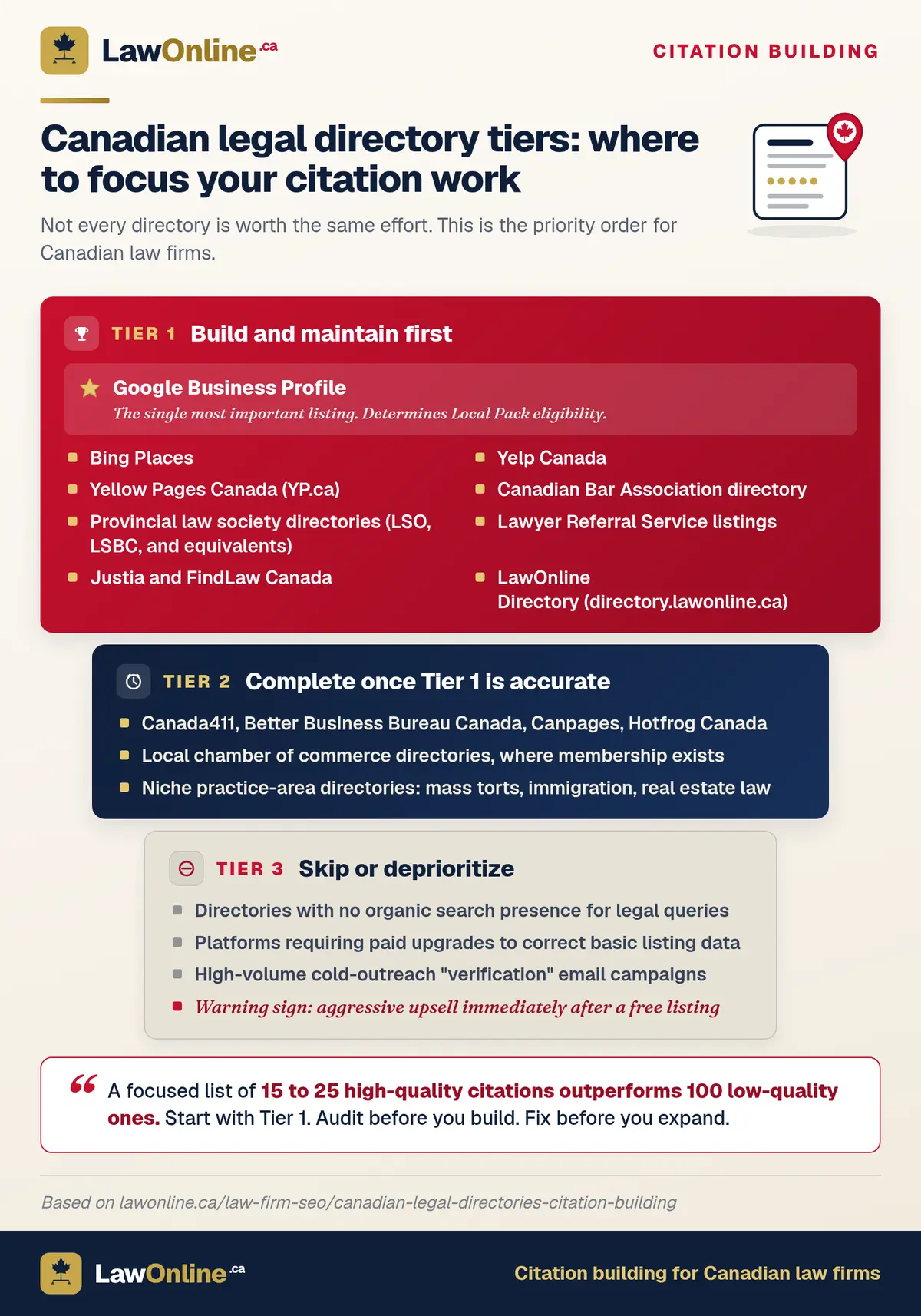
Not every directory is worth the same amount of effort. These Tier 1 Canadian and North American listings consistently contribute to local rankings for law firms.
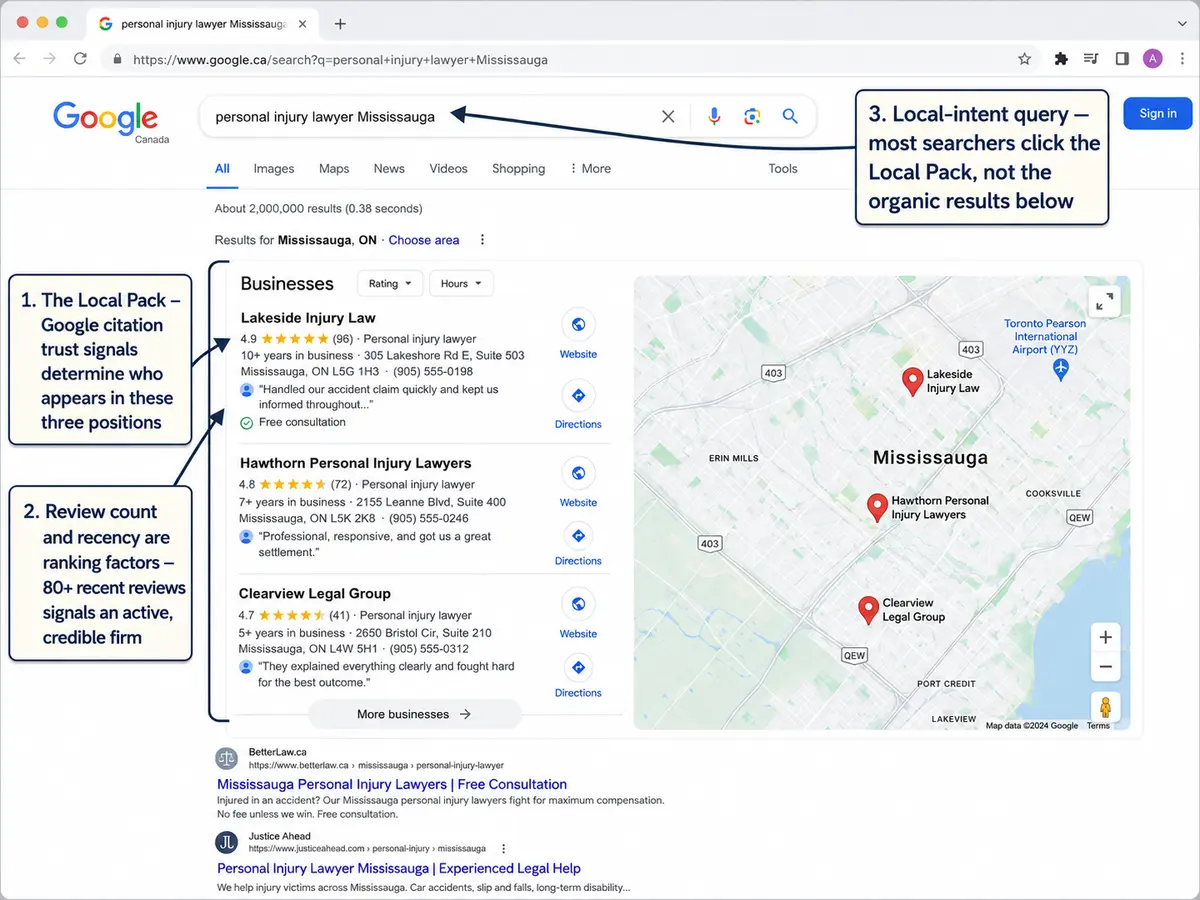
Google Business Profile. Technically not a directory, but the single most important local listing you control. Your Google Business Profile determines your eligibility for the Local Pack and Google Maps visibility. Claim it, verify it, fill out every field, select the correct legal practice categories, add photos, and keep your hours accurate. This one listing outweighs the next twenty combined. We cover GBP optimization in depth in our guide to Google Business Profile for Canadian law firms.
Bing Places. Smaller than Google, but not irrelevant. Bing still powers a meaningful share of search queries, especially on Windows devices and older browsers. The setup takes twenty minutes and the citation is valuable.
Yelp Canada. High domain authority, frequently ranks on the first page for law firm searches, and generates direct referral traffic for practice areas where reviews matter. Personal injury, family law, and immigration firms see the most benefit.
Yellow Pages Canada. Canada-specific citation with high authority and broad geographic coverage. Still one of the most frequently cited Canadian directories in local search algorithms.
Canadian Bar Association member directory. If you are a CBA member, your listing in the Canadian Bar Association directory is a high-authority legal-industry citation that non-members can't easily replicate.
Provincial law society directories. Provincial law society directories across Ontario, BC, Alberta, Quebec, and every other province maintain searchable directories of licensed lawyers. The Law Society of Ontario, Law Society of British Columbia, Law Society of Alberta, and Barreau du Québec all publish them. These directories serve a consumer-protection function, not just a listing one. The Law Society of Ontario's Lawyer and Paralegal Directory, for example, lets the public confirm a lawyer's licence status and discipline history before hiring. That regulatory authority is exactly why Google treats these listings as high-signal citations.
Lawyer Referral Service listings run by provincial bar associations carry similar weight. They're tightly gated, which is exactly why Google treats them as high-signal sources.
Justia and FindLaw Canada. Large legal-specific directories with high domain authority and substantial organic visibility.
LawOnline Directory. A Canada-specific legal directory at directory.lawonline.ca covering practice areas, office locations, and direct links to firm websites across the country. Listings are free and compiled from public sources. Firms can submit corrections or claim their profiles at no cost. LawOnline marketing clients automatically receive featured placement at the top of their region's results, also at no additional charge.
Tier 2: Useful but Lower Priority
These are worth completing once the Tier 1 listings are airtight, but don't obsess over them.
- Canada411
- Better Business Bureau Canada
- Canpages
- Hotfrog Canada
- Local chamber of commerce directories where your firm has membership
- Niche legal directories tied to specific practice areas such as mass torts, immigration law, or real estate law
Tier 3: Skip or Deprioritize
The internet is full of directories that exist primarily to sell upgraded listings. Many of them have thin traffic, low authority, and aggressive sales teams. Signs a directory isn't worth your time include:
- No organic search presence for lawyer-related queries
- Aggressive upsell attempts immediately after a free listing
- Thin or duplicative content across listings
- No review system or broken review system
- Repeated cold emails asking you to "verify" or "update" your listing
If you're getting calls and emails from a directory you've never heard of promising a premium listing for several hundred dollars per year, the answer is almost always no. Your budget is better spent on Tier 1 maintenance and content.
How to Audit Existing Citations
Before building new listings, you need to know what already exists. A surprising number of law firms have decades of citation sediment across the web, much of it with wrong or outdated data.
A citation audit covers three areas.
Search your firm name directly. Use quotation marks in Google: "Meadowbrook Injury Law" and cycle through the first five pages of results. Every unique website that mentions your firm is a citation that needs to be verified against your canonical NAP data.
Search your phone number. The same phone number with quotes, both with and without formatting variations. "416-555-1234" and "(416) 555-1234" and "4165551234" will surface different results. Any listing using a phone number that isn't yours anymore needs to be corrected or removed.
Search your old address if you have moved. Former office addresses still floating around the web are a major source of citation inconsistency for firms that have grown or relocated in the past five years.
Log every citation you find in a spreadsheet with columns for directory name, listed business name, listed address, listed phone, listed website, and a notes column. That spreadsheet becomes your remediation plan.
Fixing Bad Citations
Most Tier 1 directories let you claim and correct listings through their business portal. The process varies but typically involves verifying ownership by phone, postcard, or email.
For directories where you can't claim the listing directly, you generally have three options:
- Contact the directory's support team with evidence you're the business owner and request a manual update.
- Submit the listing to a data aggregator that syndicates corrected NAP data to multiple directories at once.
- Accept the bad listing and focus your effort on higher-value citations instead.
If a listing contains fundamentally wrong information, the previous firm name before a merger, an old office you closed years ago, a phone number that now belongs to someone else, correcting it should be a priority. Leaving it in place sends conflicting signals to Google every time the algorithm re-crawls.
How to Build New Citations for Your Law Firm
Once existing citations are clean, the building phase is straightforward but tedious. Each new Tier 1 citation takes fifteen to thirty minutes to complete properly. Don't rush through them.
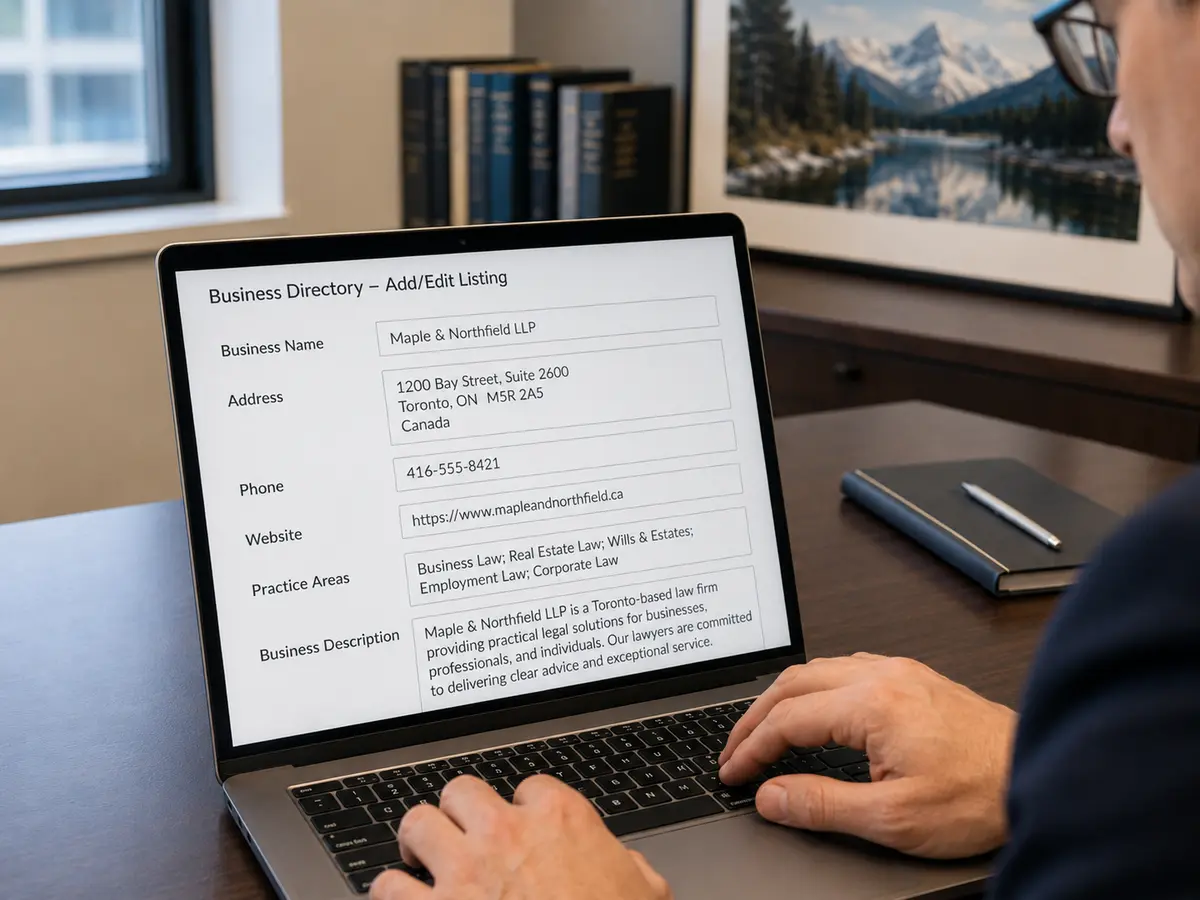
A complete legal directory listing should include:
- Exact canonical firm name
- Full address with consistent suite format
- Primary phone number in consistent format
- Website URL including www or no-www to match your canonical version
- Practice area categories selected to match what you actually handle
- Business description written specifically for that directory, not copy-pasted from your homepage
- Hours of operation
- Languages spoken if the directory supports it
- Lawyer bios where the directory supports multiple attorneys
- Professional photos when the directory allows image uploads
Budget one hour per week for citation work until your Tier 1 listings are complete and accurate. Then drop to monthly maintenance. Citations aren't a one-time project. They decay over time as directories change interfaces, lose data, or sunset features.
Common Citation-Building Mistakes
A few patterns show up again and again when firms try to do citation work themselves or through junior marketing staff.
Using different phone numbers for tracking. Many firms want to use unique tracking numbers on different directories to measure which listings drive calls. This is a citation nightmare. Google sees multiple phone numbers associated with your firm and struggles to consolidate the entity. If you need call tracking, use a dynamic number insertion solution that displays different numbers to users while keeping your canonical NAP consistent in the underlying directory data.
Bulk submission services. Services that promise to submit your firm to "500 directories" in a single afternoon are rarely worth it. Most of those directories are low-quality. Many of them will scrape bad data from each other and create a citation consistency problem that takes months to clean up.
Ignoring practice area categories. A personal injury firm that lists itself as a general "law firm" on every directory is leaving category-relevance signals on the table. Pick the most specific practice area category the directory offers.
Skipping the description field. Directory descriptions are an SEO asset when written specifically for that platform. A two-sentence description that includes your primary practice area and city, written naturally, improves your chances of ranking within the directory itself and contributes unstructured citation context.
How Citations Fit Into a Larger Local SEO Strategy
Citations are one input into local search rankings. They work alongside Google Business Profile optimization, review generation, on-page local SEO, local content, and backlinks to determine your Google Maps ranking. No amount of citation work will overcome a weak website or a thin review profile. But a strong citation foundation amplifies everything else you do. For a deeper look at how all of these local ranking factors work together, see our local SEO guide for Canadian law firms, or start with our complete guide to law firm SEO in Canada for the full picture from technical foundations to content strategy and AI-powered search.
Canada's legal market is massive but highly fragmented. The country's 14 law societies regulate more than 136,000 lawyers, according to a 2023 national report to the International Legal Aid Group, and Canadian Industry Statistics counts roughly 52,200 legal services establishments across the country, 99.5% of which have fewer than 100 employees. That's an enormous number of small firms competing locally for the same clients. For a Canadian PI firm going up against four or five similarly qualified practices in the same city, citation consistency is often the differentiator that decides who lands in the Local Pack and who gets buried below the fold.
Prioritize Tier 1 first. Audit before you build. Fix before you expand. And remember that a small number of authoritative, accurate citations beats a long list of sloppy ones every single time.
Frequently Asked Questions
How many directory listings does a Canadian law firm actually need?
A focused list of 15 to 25 high-quality citations almost always outperforms an inflated list of a hundred low-quality ones. Start with the Tier 1 directories above. Once those are accurate and consistent, add Tier 2 listings selectively where your firm has genuine reach, such as a regional chamber of commerce or a niche legal directory aligned with your primary practice area. Past that, additional citations have diminishing returns and add maintenance burden without meaningful ranking lift.
Should personal injury firms use call-tracking numbers in directory listings?
No. Different phone numbers across directories create exactly the NAP inconsistency that suppresses local rankings. If you want call tracking for marketing attribution, use dynamic number insertion on your website only. The displayed number changes per session, but the canonical phone number in your directory listings stays uniform. This protects your local SEO while still giving you the attribution data you need.
What is the difference between Google Business Profile and a legal directory?
Google Business Profile is a Google-owned product that controls your eligibility to appear in Google Maps and the Local Pack. It is the single most important local listing for any law firm. Legal directories are third-party citation sources, including Yelp, Yellow Pages, FindLaw Canada, Justia, and provincial law society directories, that signal to Google your firm is a real, established local business. You need both. The Google Business Profile drives direct visibility. The directory citations support the trust signals that determine your rankings.
How long does NAP cleanup take to improve local rankings?
Most firms see measurable Local Pack improvements within 8 to 12 weeks of a thorough NAP cleanup, though the timeline varies with how badly inconsistent the starting state is and how long it takes Google to re-crawl the corrected listings. The largest gains usually arrive within the first three months. Expect a longer ramp if your firm has a recent name change, a recent move, or significant duplicate listings to consolidate.
Are bulk citation submission services worth it for law firms?
Almost never. Bulk services optimize for the number of submissions, not the quality. Most of the directories they push to have low authority, and many scrape bad data from each other, multiplying the inconsistency problems they were supposed to solve. A focused manual approach to Tier 1 and select Tier 2 directories produces better local SEO results in less total time than running cleanup behind a bulk service for a year.