
When a lawyer hires a web development team, they're usually thinking about design. What the site looks like. Whether the typography feels authoritative. Whether the homepage photo says "serious firm" instead of "stock photo agency."
The design matters, but law firm website development is a technical discipline and the part that drives real results has nothing to do with aesthetics. It's the infrastructure underneath: how the site handles intake, how it talks to search engines, how it behaves when a potential client visits at midnight from a mobile phone, and whether it actually complies with your province's law society advertising rules. Most web developers don't build for those requirements.
The stakes are higher than many firms expect. A 2024 Thomson Reuters Institute survey of 330 Canadian lawyers found that 59% of firms report challenges acquiring new client business, and 53% struggle to demonstrate their value to potential clients. For most firms, the website is where both problems converge, and the development decisions behind it determine whether it helps or hurts.
What Website Development Means for a Law Firm
General web development and law firm website development share the same technical foundation: HTML, CSS, JavaScript, a hosting environment, a content management system. That's where the similarity ends.
A site built for a personal injury law firm in Ontario has to do things that a site built for a dentist or a retailer doesn't have to do. The development decisions that go into it reflect the specific way lawyers get clients, serve clients, and stay compliant in Canada.
Consider what happens when someone fills out a contact form on a PI firm's website at 10 PM after a car accident. Is that inquiry routed automatically into the firm's Clio intake queue, or does it land in an unmonitored email inbox? Does the contact form capture enough detail for the firm to prioritize the call? Does the site even have a mobile form that's actually usable on a phone?
These are development questions. Legal website development demands a different set of priorities, and a developer who's built sites for restaurants, dental offices, and e-commerce stores has never thought about them. The result is a site that looks professional and functions like a brochure.

What Professional Law Firm Website Development Includes
A complete website development project for law firms covers more than most firms expect when they sign a contract.
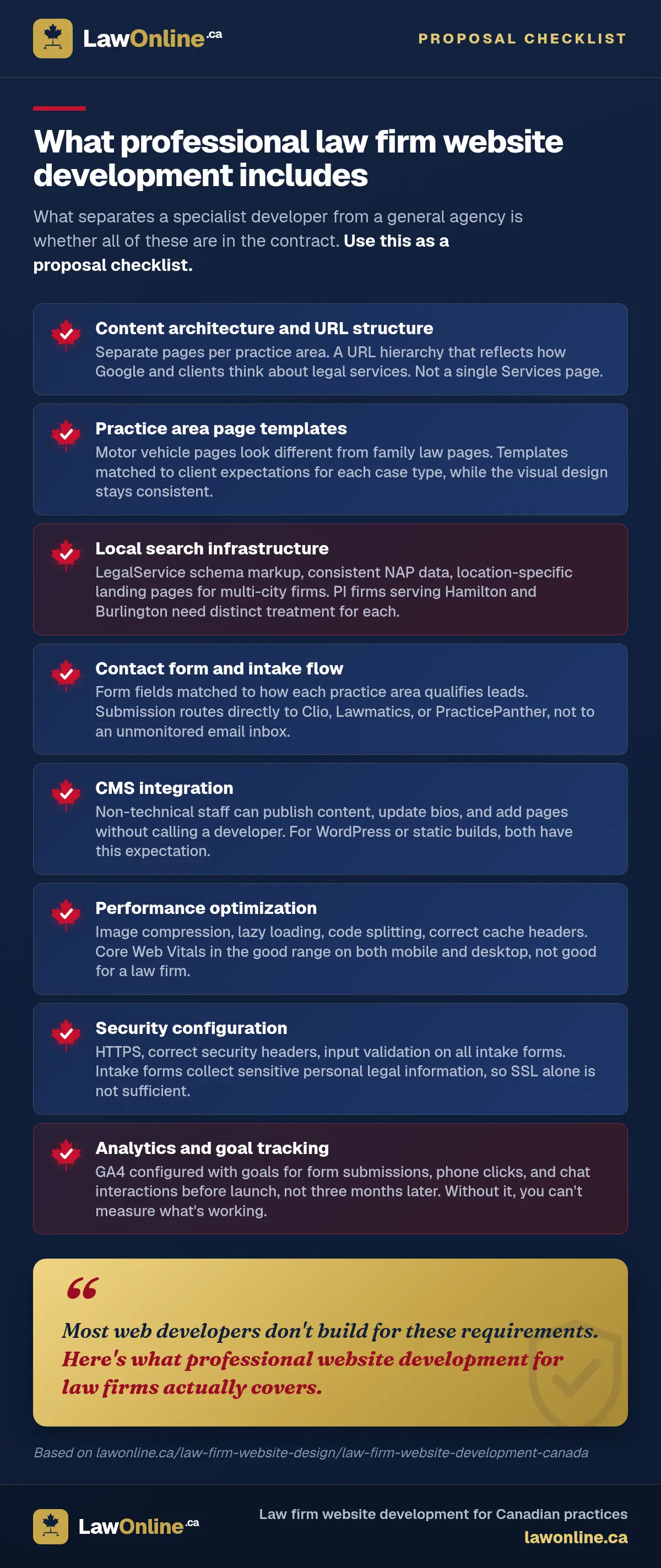
Content architecture and URL structure. A well-developed law firm site doesn't have one "services" page. It has individual pages for each practice area, organized in a hierarchy that reflects how both Google and prospective clients think about legal services. A personal injury firm needs separate pages for motor vehicle accidents, slip and fall claims, long-term disability appeals, and wrongful death. Each targets distinct search terms, addresses specific client concerns, and builds separate authority in search. Building that architecture is a development decision before it's a content decision.
Practice area page templates. Each page type needs its own layout. A motor vehicle accident page has different structural requirements than a family law page or a corporate advisory page. Good development work creates flexible templates matched to what clients expect to see for each case type, while keeping the visual design consistent across the site.
Local search infrastructure. For most law firms, local search is the primary source of qualified leads. Development has to support it. That means implementing correct law firm schema markup, including the Schema.org LegalService entity type and attorney attributes, configuring consistent NAP (name, address, phone) data across every page, and building location-specific landing pages for firms that serve multiple markets. A PI firm covering Hamilton and Burlington needs development work that treats those markets as distinct, not interchangeable.
Contact form and intake flow. This is often the highest-value component in a law firm development project. The law firm intake form for a personal injury practice should capture the type of incident, when it occurred, and the claimant's contact information in a way that's fast enough to complete under stress. The form submission needs to connect to the firm's case management system, not just send an email. For family law, the questions look different. The developer has to build forms that match how each practice area actually qualifies leads, not copy a generic template.

CMS integration. Most law firms run on WordPress. Some teams are moving to custom static site builds for performance. See our comparison of WordPress vs. static law firm websites if you're still deciding on a platform. Whichever system you choose, the CMS needs to let non-technical staff publish content, update staff bios, and add new pages without calling a developer. Lawyers don't update their own sites, but someone at the firm will need to eventually.
Performance optimization. Law firm sites need to be fast. Not "fast for a law firm" but genuinely fast, with Core Web Vitals scores in the good range on both mobile and desktop. This requires image compression, lazy loading, code splitting, proper cache headers, and a hosting environment that serves assets quickly. For personal injury firms and family law practices that compete on responsiveness, a slow website is a direct competitive disadvantage. A potential client who waits five seconds for your homepage to load has already gone back to Google.
Security configuration. Every law firm site needs HTTPS, correct security headers, and input validation on all forms. Law firm intake forms collect sensitive personal information from people describing accidents, divorces, and criminal matters. That data requires careful handling. A developer who sets up SSL and calls security "done" isn't finished.
Bilingual readiness. Firms serving Quebec or bilingual markets in Ontario, New Brunswick, or Manitoba need a bilingual law firm website that handles French content without fragmenting the site's authority signals. This means proper hreflang implementation, French-language metadata, and a content management setup that makes bilingual publishing manageable for non-technical staff. It's a non-trivial development lift that general agencies regularly underestimate.
Analytics and goal tracking. A completed development project should include GA4 configured with goals set for form submissions, phone clicks, and any chat interactions. Without proper tracking, the firm has no way to measure which pages are generating inquiries, which practice area content is actually working, or whether a site redesign improved results. This isn't optional instrumentation; it's the feedback loop the whole marketing effort depends on.
The gap between intention and practice is wider than most firms realize. The same Thomson Reuters survey found that 92% of Canadian law firms include client satisfaction in their definition of success, but only 46% actually track it. Proper analytics configuration closes that gap by connecting what the firm values to what it can measure.
What General Web Developers Get Wrong
The gaps in law firm web development don't usually show up on launch day. They show up three months later when the intake volume doesn't match the traffic data, or six months in when the site isn't ranking.
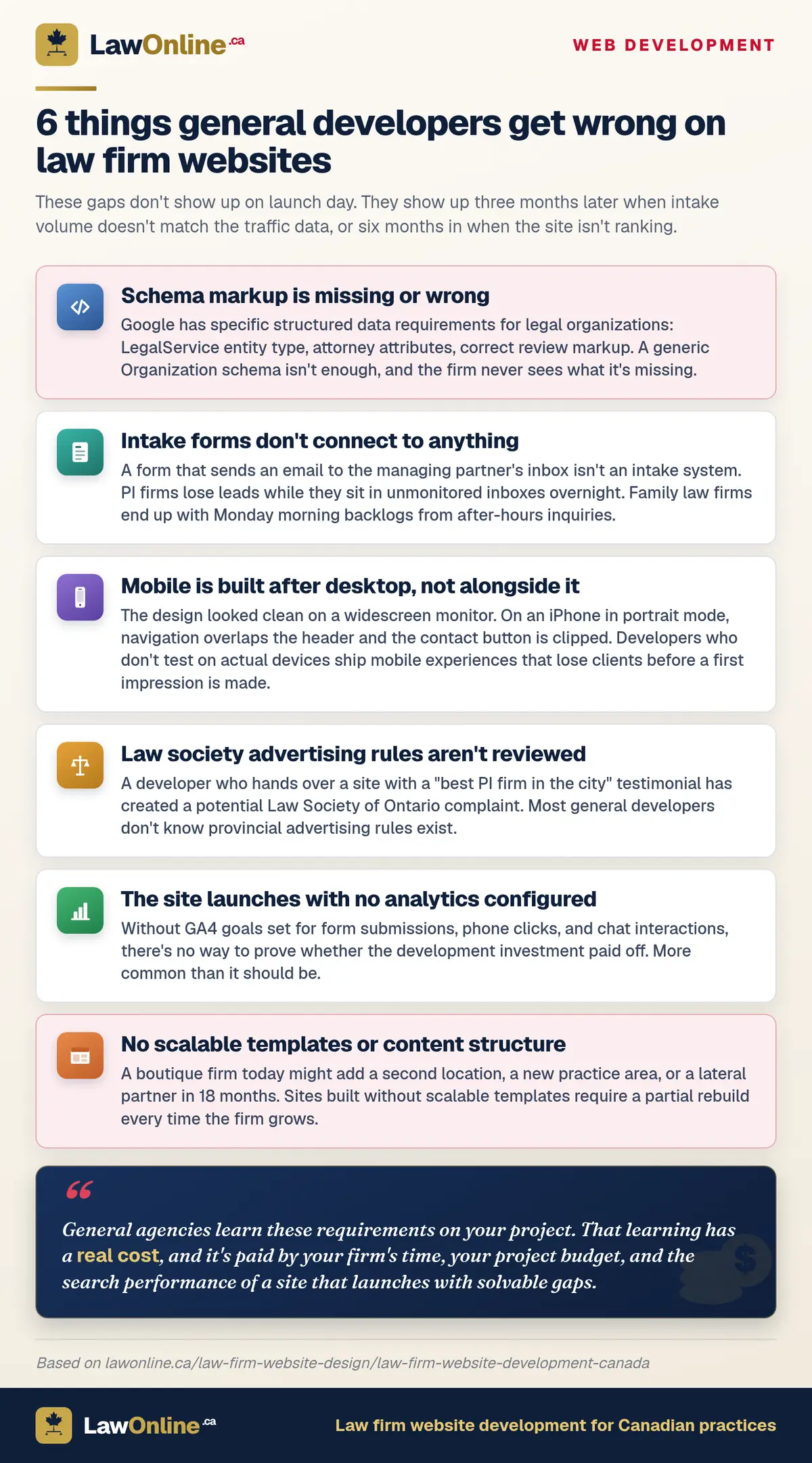
Schema markup is missing or wrong. Google has specific structured data requirements for legal organizations. Correct law firm schema markup requires the LegalService entity type, the attorney attributes, and proper review markup. A developer who adds generic Organization markup and moves on is leaving local search signals on the table.
Intake forms don't connect to anything. A form that sends an email to the managing partner's inbox isn't an intake system. For personal injury firms with high inquiry volume, this means leads going cold before anyone responds. For family law firms with after-hours inquiries, it means Monday morning backlogs. The development work has to connect the form to the firm's actual workflow, or the whole point of the website is missed.
Mobile is an afterthought. The design looked clean on a widescreen monitor. On an iPhone in portrait mode, the navigation overlaps the header and the contact button is clipped. Developers who don't test on actual devices ship mobile experiences that lose clients before anyone has made a first impression. Given that most searches for lawyers happen on mobile, this isn't a minor issue.
Law society advertising compliance isn't checked. A developer who hands over a site with a "best PI firm in the city" testimonial displayed without any vetting has created a potential Law Society of Ontario complaint. Ensuring law firm website compliance requires at least a baseline review of what your province's law society advertising rules restrict before content goes live. Most general developers don't know those rules exist.
There's no measurement baseline. Launching a site without configured analytics means there's no way to prove whether the development investment paid off. This is more common than it should be.
The site wasn't built to scale. A boutique firm today might add a second location, a new practice area, or a lateral partner with a different specialty in 18 months. Sites built without scalable templates and content structures require a partial rebuild every time the firm grows. Good development anticipates this from the start.
Timeline: What to Expect
A professional law firm website development project runs 10 to 16 weeks from kick-off to launch, depending on firm size, number of practice areas, and how quickly the client delivers content and approvals.
The four phases: discovery and strategy (weeks 1-2), design and development (weeks 3-8), content integration and testing (weeks 9-12), and launch plus post-launch monitoring (weeks 13-16). For a detailed look at each phase and what your firm is responsible for at every stage, see our law firm website design process guide.
A small boutique with two practice areas and quick internal turnarounds can compress this to 10 weeks. A multi-practice firm with bilingual content, Clio integrations, and six or more practice areas routinely runs to 16 weeks. Any agency promising a full custom build in four weeks is either shipping a template or cutting major corners.
Budget Ranges in Canada
Law firm website development in Canada ranges from roughly $8,000 for a lean single-practice boutique to $50,000 or more for a large multi-practice firm with complex integration requirements. For a complete tier-by-tier cost breakdown, see our law firm website cost guide.
The biggest cost driver isn't the visual design. It's the number of practice area pages, the complexity of intake integrations, and how much content strategy and writing the development partner is expected to contribute.
A personal injury firm with 12 targeted practice area pages, Clio intake integration, multilingual content for Quebec, and a location-specific landing page for each of six cities it serves is a meaningfully more complex project than a solo practitioner's corporate advisory site.
A Note on the Toronto Market
Toronto is Canada's most competitive legal market, and the stakes for law firm website development are proportionally higher. The Law Society of Ontario's 2023 annual report counted 43,772 lawyers actively practising in the province, with a disproportionate concentration in the GTA. Personal injury, family law, and immigration firms in the GTA are competing against dozens of practices with mature web presences, established local search signals, and significant development investment behind their sites.
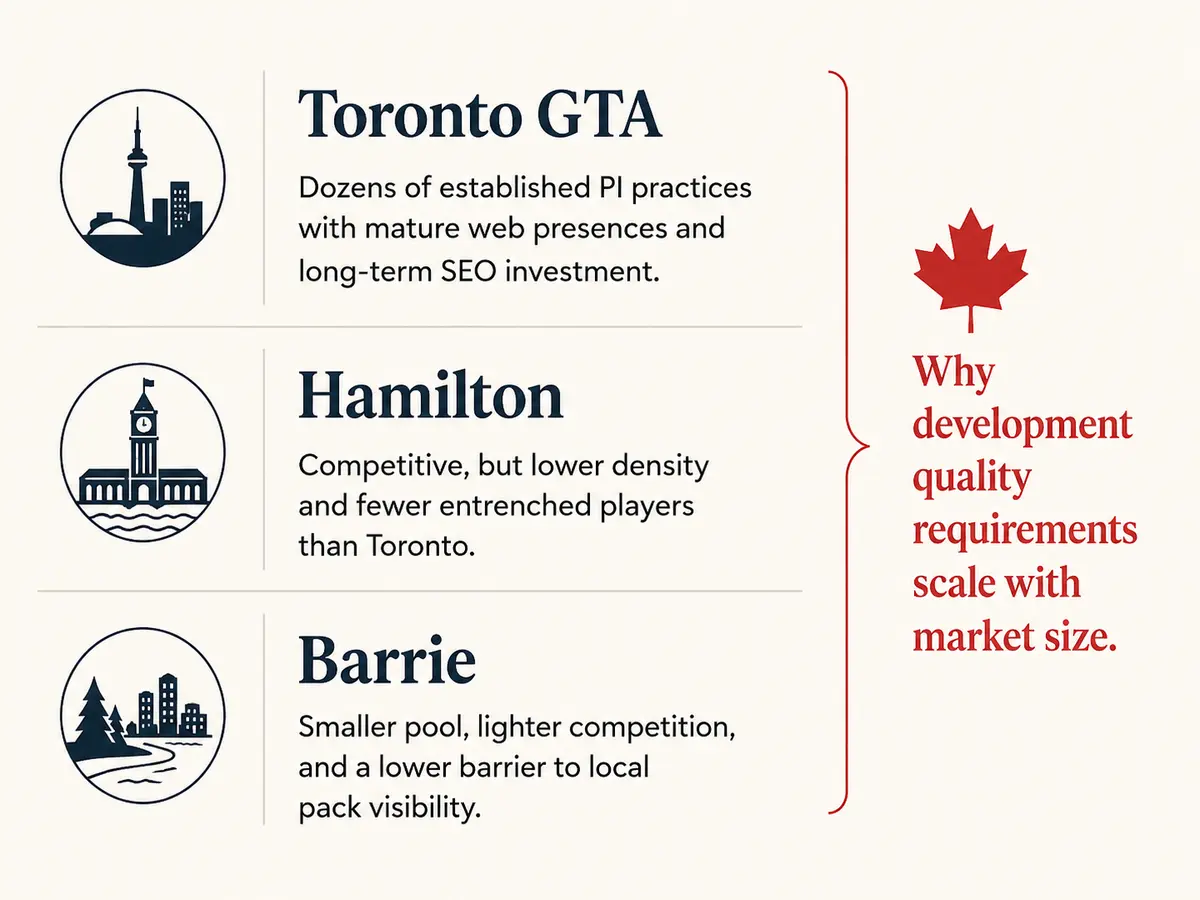
A PI firm in Scarborough competing for "car accident lawyer Toronto" isn't just competing against a mediocre site; it's competing against firms that have been investing in their web infrastructure for years. The development quality gap is real, and it compounds over time. Firms that built strong technical foundations in 2022 and 2023 now have search positions that require sustained effort to displace.
If you're investing in law firm web development in Toronto, the quality requirements are higher than they'd be in a smaller market. More thorough practice area coverage, better intake systems, and stronger technical SEO implementation are all necessary, not optional.
Choosing a Development Partner
The most important criterion is direct, demonstrated experience with law firm websites in Canada. A law firm website developer who has built 15 sites for practices like yours has encountered every intake edge case, knows the law society advertising questions to raise before launch, and has already solved the Schema markup problems that stump general developers.
General web agencies learn on your project. That learning has a real cost, and it's paid by your firm's time, your project budget, and the search performance of a site that launches with solvable gaps.
For a detailed framework on evaluating candidates, vetting portfolios, and spotting red flags before you sign, our full law firm web design guide covers the complete evaluation process.